


Page 26 - (DK Eyewitness) Travel Guide - New Orleans
P. 26
24 INTRODUCING NE W ORLEANS
During World War II, business picked up
again in the shipyards, and New Orleans
produced thousands of the famous
Higgins boats that were used in Allied
amphibious landings on all war fronts.
In 1946, Mayor deLesseps Story “Chep”
Morrison was elected as a reformer and
served until 1961. During his administration,
the city began to take on its current appear
ance. He constructed the Pontchartrain
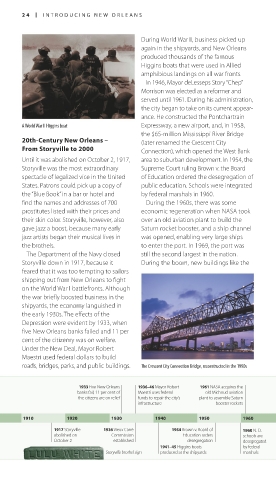
A World War II Higgins boat Expressway, a new airport, and, in 1958,
the $65million Mississippi River Bridge
20th-Century New Orleans – (later renamed the Crescent City
From Storyville to 2000 Connection), which opened the West Bank
Until it was abolished on October 2, 1917, area to suburban development. In 1954, the
Storyville was the most extraordinary Supreme Court ruling Brown v. the Board
spectacle of legalized vice in the United of Education ordered the desegregation of
States. Patrons could pick up a copy of public education. Schools were integrated
the “Blue Book” in a bar or hotel and by federal marshals in 1960.
find the names and addresses of 700 During the 1960s, there was some
prostitutes listed with their prices and economic regeneration when NASA took
their skin color. Storyville, however, also over an old aviation plant to build the
gave jazz a boost, because many early Saturn rocket booster, and a ship channel
jazz artists began their musical lives in was opened, enabling very large ships
the brothels. to enter the port. In 1969, the port was
The Department of the Navy closed still the second largest in the nation.
Storyville down in 1917, because it During the boom, new buildings like the
feared that it was too tempting to sailors
shipping out from New Orleans to fight
on the World War I battlefronts. Although
the war briefly boosted business in the
shipyards, the economy languished in
the early 1930s. The effects of the
Depression were evident by 1933, when
five New Orleans banks failed and 11 per
cent of the citizenry was on welfare.
Under the New Deal, Mayor Robert
Maestri used federal dollars to build
roads, bridges, parks, and public buildings. The Crescent City Connection Bridge, reconstructed in the 1990s
1933 Five New Orleans 1936–46 Mayor Robert 1961 NASA acquires the 1975 Super
banks fail; 11 per cent of Maestri uses federal old Michoud aviation dome opens
the citizens are on relief funds to repair the city’s plant to assemble Saturn
infrastructure booster rockets
1910 1920 1930 1940 1950 1960
1917 Storyville 1936 Vieux Carré 1954 Brown v. Board of 1960 N. O.
abolished on Commission Education orders schools are
October 2 established desegregation desegregated
1941–45 Higgins boats by federal
Storyville brothel sign produced at the shipyards marshals
024-025_EW_New_Orl.indd 24 05/08/16 3:48 pm
Eyewitness Travel LAYERS PRINTED:
History Portrait template “UK” LAYER
(Source v1.2)
Date 20th August 2012
Size 125mm x 217mm

