


Page 33 - (DK Eyewitness) Travel Guide - New Orleans
P. 33
THE HIST OR Y OF NE W ORLEANS 31
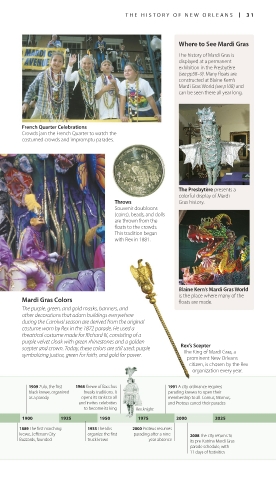
Where to See Mardi Gras
The history of Mardi Gras is
displayed at a permanent
exhibition in the Presbytère
(see pp58–9). Many floats are
constructed at Blaine Kern’s
Mardi Gras World (see p108) and
can be seen there all year long.
French Quarter Celebrations
Crowds jam the French Quarter to watch the
costumed crowds and impromptu parades.
The Presbytère presents a
colorful display of Mardi
Throws Gras history.
Souvenir doubloons
(coins), beads, and dolls
are thrown from the
floats to the crowds.
This tradition began
with Rex in 1881.
Blaine Kern’s Mardi Gras World
is the place where many of the
Mardi Gras Colors floats are made.
The purple, green, and gold masks, banners, and
other decorations that adorn buildings everywhere
during the Carnival season are derived from the original
costume worn by Rex in the 1872 parade. He used a
theatrical costume made for Richard III, consisting of a
purple velvet cloak with green rhinestones and a golden
scepter and crown. Today, these colors are still used: purple Rex’s Scepter
The King of Mardi Gras, a
symbolizing justice, green for faith, and gold for power.
prominent New Orleans
citizen, is chosen by the Rex
organization every year.
1909 Zulu, the first 1968 Krewe of Bacchus 1991 A city ordinance requires
black krewe, organized breaks traditions. It parading krewes to open their
as a parody opens its ranks to all membership to all. Comus, Momus,
and invites celebrities and Proteus cancel their parades
to become its king Rex knight
1900 1925 1950 1975 2000 2025
1889 The first marching 1935 The Elks 2000 Proteus resumes
krewe, Jefferson City organize the first parading after a nine- 2008 The city returns to
Buzzards, founded truck krewe year absence its pre-Katrina Mardi Gras
parade schedule, with
11 days of festivities
030-031_EW_New_Orl.indd 31 05/08/16 3:56 pm

