


Page 36 - (DK Eyewitness) Travel Guide - New Orleans
P. 36
34 INTRODUCING NE W ORLEANS
Exploring New Orleans’ The Spanish
Many Cultures The Spanish took over from the
French as administrators of
New Orleans’ unique flavor derives from the incredible mix Louisiana from 1763 to 1800
of peoples and cultures assembled on the banks of the (see pp18–19), but few immigrants
Mississippi River; Native American, French, Spanish, African, from Spain actually settled in
New Orleans. Spanish is still
Anglo-American, Jewish, Italian, German, and Irish. They spoken by descendants of the
have all contributed to the “gumbo” that is New Orleans. “Isleños” – those who came at the
request of the Spanish from the
Canary Islands in the 1770s. In
the 1950s, Latin American
refugees from Cuba, Nicaragua,
and Honduras flooded into the
city. The most obvious Hispanic
influence can be seen
throughout the French Quarter
in the design of the buildings.
The Germans
The first Germans arrived in
1722, lured by John Law’s
promotion of the colony as
an earthly paradise (see p17).
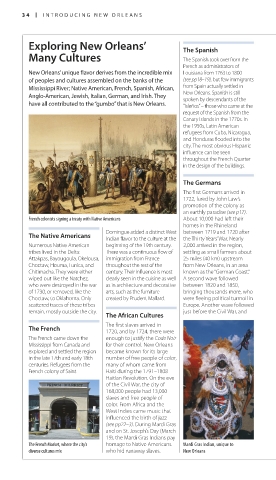
French colonists signing a treaty with Native Americans About 10,000 had left their
homes in the Rhineland
Domingue added a distinct West between 1719 and 1720 after
The Native Americans Indian flavor to the culture at the the Thirty Years’ War. Nearly
Numerous Native American beginning of the 19th century. 2,000 arrived in the region,
tribes lived in the Delta: There was a continuous flow of settling as small farmers about
Attakpas, Bayougoula, Okelousa, immigration from France 25 miles (40 km) upstream
Choctaw, Houma, Tunica, and throughout the rest of the from New Orleans, in an area
Chitimacha. They were either century. Their influence is most known as the “German Coast.”
wiped out like the Natchez, clearly seen in the cuisine as well A second wave followed
who were destroyed in the war as in architecture and decorative between 1820 and 1850,
of 1730, or removed, like the arts, such as the furniture bringing thousands more, who
Choctaw, to Oklahoma. Only created by Prudent Mallard. were fleeing political turmoil in
scattered traces of these tribes Europe. Another wave followed
remain, mostly outside the city. just before the Civil War, and
The African Cultures
The first slaves arrived in
The French 1720, and by 1724, there were
The French came down the enough to justify the Code Noir
Mississippi from Canada and for their control. New Orleans
explored and settled the region became known for its large
in the late 17th and early 18th number of free people of color,
centuries. Refugees from the many of whom came from
French colony of Saint Haiti during the 1791–1808
Haitian Revolution. On the eve
of the Civil War, the city of
168,000 people had 13,000
slaves and free people of
color. From Africa and the
West Indies came music that
influenced the birth of jazz
(see pp22–3). During Mardi Gras
and on St. Joseph’s Day (March
19), the Mardi Gras Indians pay
The French Market, where the city’s homage to Native Americans Mardi Gras Indian, unique to
diverse cultures mix who hid runaway slaves. New Orleans
034-035_EW_New_Orl.indd 34 05/08/16 3:48 pm
Eyewitness Travel LAYERS PRINTED:
Feature template “UK” LAYER
(SourceReport v1.5)
Date 15th October 2013
Size 125mm x 217mm

