


Page 86 - (DK Eyewitness) Travel Guide - New Orleans
P. 86
84 NE W ORLEANS AREA B Y AREA
time accepted Boré contributed much to the
Protestants (although city’s prosperity as he was the
these graves were first to granulate sugar on a
later moved). There commercial scale in 1796.
are numerous Boré’s grandson, the historian
legendary local Charles Gayarré, is also buried
figures buried here, here, as is Paul Morphy (1837–
including Homer 84), the genius chess player
Adolph Plessy who was a world champion
(1862–1925), who at age 13 but who later went
challenged the mad. Most famous of all is
segregation laws in probably Marie Laveau (see box,
the 1890s (see p21); opposite), known as the
and Bernard de voodoo queen. Crowds visit
Marigny (1788–1871), her tomb (though some
who inherited the believe it is not the correct
sum of $7 million at one) to leave unusual voodoo
age 15 and “gifts” or mark it with X’s, which
squandered it playing symbolizes a request that she
craps (dice), the grant a particular wish. A more
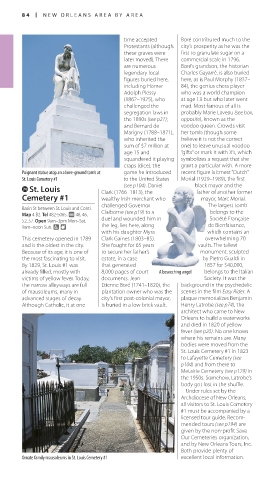
Poignant statue atop an above-ground tomb at game he introduced recent figure is Ernest “Dutch”
St. Louis Cemetery #1 to the United States Morial (1929–1989), the first
(see p104). Daniel
f St. Louis Clark (1766–1813), the black mayor and the
father of another former
Cemetery #1 wealthy Irish merchant who mayor, Marc Morial.
challenged Governor The largest tomb
Basin St between St. Louis and Conti.
Map 4 B2. Tel 482-5065. @ 48, 46, Claiborne (see p19) to a belongs to the
52, 57. Open 9am–3pm Mon–Sat, duel and wounded him in Société Française
9am–noon Sun. 7 8 the leg, lies here, along de Bien faisance,
with his daughter Myra which contains an
This cemetery opened in 1789 Clark Gaines (1803–85). overwhelming 70
and is the oldest in the city. She fought for 65 years vaults. The tallest
Because of its age, it is one of to secure her father’s monument, sculpted
the most fascinating to visit. estate, in a case by Pietro Gualdi in
By 1829, St. Louis #1 was that generated 1857 for $40,000,
already filled, mostly with 8,000 pages of court A beseeching angel belongs to the Italian
victims of yellow fever. Today, documents. Jean Society. It was the
the narrow alleyways are full Etienne Boré (1741–1820), the background in the psychedelic
of maus oleums, many in plantation owner who was the scenes in the film Easy Rider. A
advanced stages of decay. city’s first post-colonial mayor, plaque memorializes Benjamin
Although Catholic, it at one is buried in a low brick vault. Henry Latrobe (see p74), the
architect who came to New
Orleans to build a waterworks
and died in 1820 of yellow
fever (see p20). No one knows
where his remains are. Many
bodies were moved from the
St. Louis Cemetery #1 in 1823
to Lafayette Cemetery (see
p104) and from there to
Metairie Cemetery (see p129) in
the 1950s. Somehow, Latrobe’s
body got lost in the shuffle.
Under rules set by the
Archdiocese of New Orleans,
all visitors to St. Louis Cemetery
#1 must be accompanied by a
licensed tour guide. Recom-
mended tours (see p194) are
given by the non-profit Save
Our Cemeteries organization,
and by New Orleans Tours, Inc.
Both provide plenty of
Ornate family mausoleums in St. Louis Cemetery #1 excellent local information.
084-085_EW_New_Orl.indd 84 05/08/16 3:49 pm
Eyewitness Travel LAYERS PRINTED:
Catalogue template “UK” LAYER
(Source v2.7)
Date 1st October 2013
Size 125mm x 217mm

