


Page 83 - (DK Eyewitness) Travel Guide - New Orleans
P. 83
L OWER FRENCH QU AR TER , M ARIGN Y , AND TREME 81
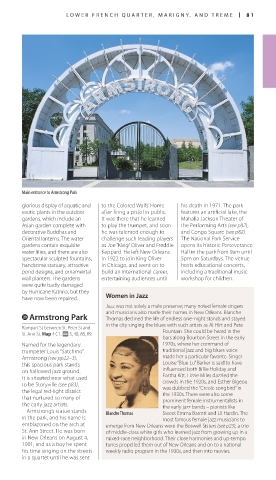
Main entrance to Armstrong Park
glorious display of aquatic and to the Colored Waifs’ Home his death in 1971. The park
exotic plants in the outdoor after firing a pistol in public. features an artificial lake, the
gardens, which include an It was there that he learned Mahalia Jackson Theater of
Asian garden complete with to play the trumpet, and soon the Performing Arts (see p82),
decorative Buddhas and he was talented enough to and Congo Square (see p82).
Oriental lanterns. The water challenge such leading players The National Park Service
gardens contain exquisite as Joe “King” Oliver and Freddie opens its historic Perseverance
water lilies, and there are also Keppard. He left New Orleans Hall in the park from 9am until
spectacular sculpted fountains, in 1922 to join King Oliver 5pm on Saturdays. The venue
handsome statuary, attractive in Chicago, and went on to hosts educational concerts,
pond designs, and ornamental build an international career, including a traditional music
wall planters. The gardens entertaining audiences until workshop for children.
were quite badly damaged
by Hurricane Katrina, but they
have now been repaired. Women in Jazz
Jazz was not solely a male preserve; many noted female singers
and musicians also made their names in New Orleans. Blanche
p Armstrong Park Thomas declined the life of endless one-night stands and stayed
in the city singing the blues with such artists as Al Hirt and Pete
Rampart St between St. Peter St and
St. Ann St. Map 4 C1. @ 5, 48, 88, 89. Fountain. She could be heard in the
bars along Bourbon Street in the early
Named for the legendary 1970s, where her command of
trumpeter Louis “Satchmo” traditional jazz and big blues voice
Armstrong (see pp22–3), made her a particular favorite. Singer
this spacious park stands Louise “Blue Lu” Barker is said to have
on hallowed jazz ground. influenced both Billie Holiday and
It is situated near what used Eartha Kitt. Lizzie Miles dazzled the
crowds in the 1920s, and Esther Bigeou
to be Storyville (see p83), was dubbed the “Creole songbird” in
the legal red-light district the 1930s. There were also some
that nurtured so many of prominent female instrumentalists in
the early jazz artists. the early jazz bands – pianists like
Armstrong’s statue stands Blanche Thomas Sweet Emma Barrett and Lil Hardin. The
in the park, and his name is most famous female jazz musicians to
emblazoned on the arch at emerge from New Orleans were the Boswell Sisters (see p23), a trio
St. Ann Street. He was born of middle-class white girls who learned jazz from growing up in a
in New Orleans on August 4, mixed-race neighborhood. Their close harmonies and up-tempo
1901, and as a boy he spent tunes propelled them out of New Orleans and on to a national
his time singing on the streets weekly radio program in the 1930s, and then into movies.
in a quartet until he was sent
080-081_EW_New_Orl.indd 81 05/08/16 3:49 pm

