


Page 85 - (DK Eyewitness) Travel Guide - New Orleans
P. 85
L OWER FRENCH QU AR TER , M ARIGN Y , AND TREME 83
of the French Quarter in 1826, something in a hurry. St. Expedite
when funerals were no longer is also associated with voodoo
being held in St. Louis Cathedral, (see p85), which is why the
for fear of spreading yellow fever church is called the “voodoo
(see p20). It was originally known church.” Guadalupe is the official
as “Mortuary Chapel” because all place of worship for the police
the bodies were taken directly and fire departments, whose
from the chapel to St. Louis altar stands to the right of
Cemetery #1 (see p84), via the the main altar.
back entrance. It displays several
brilliantly colored stained-glass
windows, representing different
saints honored by devoted
New Orleanians.
The most visited altar is
dedicated to St. Jude, the “patron
saint of hopeless causes,” but a
more light-hearted one stands to
the left of the exit; this is
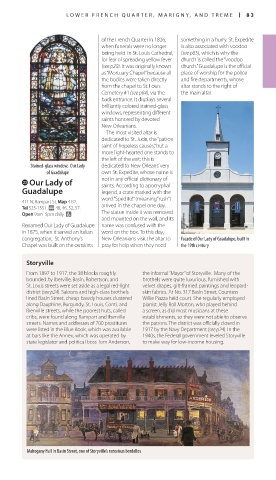
Stained-glass window, Our Lady dedicated to New Orleans’ very
of Guadalupe own St. Expedite, whose name is
d Our Lady of not in any official dictionary of
saints. According to apocryphal
Guadalupe legend, a crate marked with the
word “Spedito!” (meaning “rush”)
411 N. Rampart St. Map 4 B2.
Tel 525-1551. @ 48, 46, 52, 57. arrived in the chapel one day.
Open 9am–5pm daily. 7 The statue inside it was removed
and mounted on the wall, and its
Renamed Our Lady of Guadalupe name was confused with the
in 1875, when it served an Italian word on the box. To this day,
congregation, St. Anthony’s New Orleanians visit the altar to Facade of Our Lady of Guadalupe, built in
Chapel was built on the outskirts pray for help when they need the 19th century
Storyville
From 1897 to 1917, the 38 blocks roughly the informal “Mayor” of Storyville. Many of the
bounded by Iberville, Basin, Robertson, and brothels were quite luxurious, furnished with
St. Louis streets were set aside as a legal red-light velvet drapes, gilt-framed paintings and leopard-
district (see p24). Saloons and high-class brothels skin fabrics. At No. 317 Basin Street, Countess
lined Basin Street, cheap bawdy houses clustered Willie Piazza held court. She regularly employed
along Dauphine, Burgundy, St. Louis, Conti, and pianist Jelly Roll Morton, who played behind
Bienville streets, while the poorest huts, called a screen, as did most musicians at these
cribs, were found along Rampart and Iberville establishments, so they were not able to observe
streets. Names and addresses of 700 prostitutes the patrons. The district was officially closed in
were listed in the Blue Book, which was available 1917 by the Navy Department (see p24). In the
at bars like the Annex, which was operated by 1940s, the Federal government leveled Storyville
state legislator and political boss Tom Anderson, to make way for low-income housing.
Mahogany Hall in Basin Street, one of Storyville’s notorious bordellos
082-083_EW_New_Orl.indd 83 05/08/16 3:49 pm

