


Page 87 - (DK Eyewitness) Travel Guide - New Orleans
P. 87
L OWER FRENCH QU AR TER , M ARIGN Y , AND TREME 85
Voodoo Worship
Voodoo arrived in New Orleans from Africa, via the Caribbean,
where it originated as a form of ancestor worship among the
West African tribes who were brought to North America as
slaves. With the revolution in Saint Domingue in 1793, slaves
and free people of color arrived as refugees and increased the
practice in the city. Voodoo enabled those slaves to preserve
their African culture and roots alongside the Roman Catholic
religion, for it mixed both traditions. The most famous of all
19th-century voodoo leaders was Marie Laveau (c.1794–1881),
a mulatto and a great marketer. She used such Catholic
elements as prayer, incense, and saints in her rituals, which she
opened to the public for an admission fee. The high point of
the voodoo calendar was the celebration she held along the
Bayou St. John on St. John’s Eve. She is believed to be buried
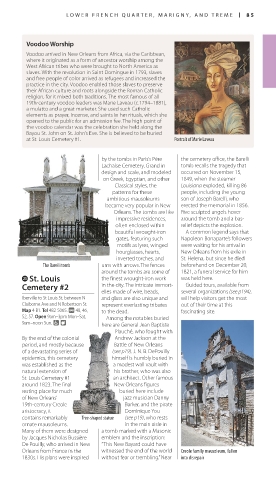
at St. Louis Cemetery #1. Portrait of Marie Laveau
by the tombs in Paris’s Père the cemetery office, the Barelli
Lachaise Cemetery. Grand in tomb recalls the tragedy that
design and scale, and modeled occurred on November 15,
on Greek, Egyptian, and other 1849, when the steamer
Classical styles, the Louisiana exploded, killing 86
patterns for these people, including the young
ambitious mausoleums son of Joseph Barelli, who
became very popular in New erected the memorial in 1856.
Orleans. The tombs are like Five sculpted angels hover
impressive residences, around the tomb and a bas-
often enclosed within relief depicts the explosion.
beautiful wrought-iron A common legend says that
gates, featuring such Napoleon Bonaparte’s followers
motifs as lyres, winged were waiting for his arrival in
hourglasses, hearts, New Orleans from his exile in
inverted torches, and St. Helena, but since he died
The Barelli tomb urns with arrows. The fences beforehand on December 20,
around the tombs are some of 1821, a funeral service for him
g St. Louis the finest wrought-iron work was held here.
Cemetery #2 in the city. The intricate immort- Guided tours, available from
elles made of wire, beads, several organizations (see p194),
Iberville to St Louis St, between N and glass are also unique and will help visitors get the most
Claiborne Ave and N Robertson St. represent ever lasting tributes out of their time at this
Map 4 B1. Tel 482-5065. @ 48, 46, to the dead. fascinating site.
52, 57. Open 9am–3pm Mon–Sat, Among the notables buried
9am–noon Sun. 7 8 here are General Jean Baptiste
Plauché, who fought with
By the end of the colonial Andrew Jackson at the
period, and mostly because Battle of New Orleans
of a devastating series of (see p19). J. N. B. DePouilly
epidemics, this cemetery himself is humbly buried in
was established as the a modest wall vault with
natural extension of his brother, who was also
St. Louis Cemetery #1 an architect. Other famous
around 1823. The final New Orleans figures
resting place for much buried here include
of New Orleans’ jazz musician Danny
19th-century Creole Barker, and the pirate
aristocracy, it Dominique You
contains remarkably Tree-shaped statue (see p19), who rests
ornate mausoleums. in the main aisle in
Many of them were designed a tomb marked with a Masonic
by Jacques Nicholas Bussière emblem and the inscription:
De Pouilly, who arrived in New “This New Bayard could have
Orleans from France in the witnessed the end of the world Creole family mausoleum, fallen
1830s. His plans were inspired without fear or trembling.” Near into disrepair
084-085_EW_New_Orl.indd 85 05/08/16 3:49 pm

