


Page 59 - History of War - Issue 25-16
P. 59
FORGING THE ULTIMATE BLADE


                                                         n the
                                                         n customised
                                                         ravings      THE LOST

                                                                      BAMBURGH


                                                                      BLADE


                                                                      WAS THIS WEAPON THE PINNACLE OF SWORD DESIGN?
            SABRE                                                     The Bamburgh Sword, forged in the  In a time when modern science was
                                                                      7th century, excavated in 1960 and
                                                                                                  hundreds of years in the future, the
            The sabre – as most often thought –                       rediscovered in 2001, is possibly  creation of a perfect blade was a
            was a curved, single-edged blade used                     the inest blade ever made, being  process of magic and ritual.
            by cavalrymen, in particular during the                   created using six strands of pattern-  The very best Early Medieval
            Napoleonic Wars, when it was wielded to                   welded iron. An extraordinary  blades had wootz steel (crucible
            sometimes devastating effect on routing                   weapon like this was the work of  steel imported from India) alloyed
            infantry formations. But in fact, Napoleonic-             more than one man and was likely  into the pattern welding. This raised
            era sabres were just as often straight                    forged for a royal owner.   the quality of the blades hugely.
            blades, used for thrusting attacks by                       The blade, the hilt and the  The Bamburgh hilt was made of
            charging cavalry. The sabre remains part                  scabbard were made by different  precious metal and stones. Garnets
            of the dress uniform of many military units,              people, each a master of his craft.  were a favourite; each one was hand
            while modern sport sabre fencing is alone in              The technology that went into  shaped by cutting and laboriously
            counting slashing strokes as hits, although               creating a pattern-welded sword is  polished with a mix of fat and
            the sword itself is straight, not curved.                 extremely complicated and takes  crushed stone loaded onto a leather
                                                                      a lifetime to perfect. The men  pad. The gold work would have
            “THE SABRE REMAINS PART OF THE                            who had this skill were venerated  been extraordinary and the level of
                                                                                                  minute detail must have required
                                                                      and rewarded richly. However, the
            DRESS UNIFORM OF MANY MILITARY UNITS”                     technology was jealously guarded,  an immense amount of time and
                                                                      so bladesmiths were not free to
                                                                                                  patience. How this was done without
                                                                      leave the king who employed them.  magniication is a mystery still.
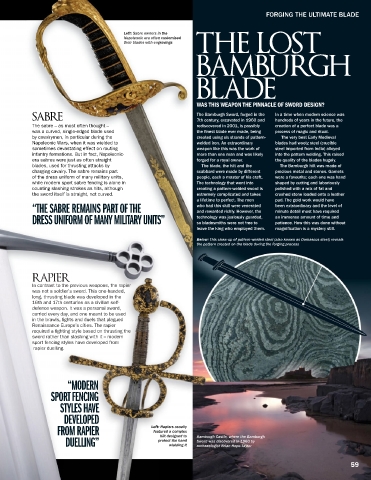
                                                                      Below: This close-up of pattern-welded steel (also known as Damascus steel) reveals
                                                                      the pattern created on the blade during the forging process


                         “MODERN

                   SPORT FENCING
                      STYLES HAVE

                        DEVELOPED
                     FROM RAPIER                      Left: Rapiers usually
                                                       featured a complex
                                                         hilt designed to
                                                                           gh Castle, where the Bamburgh
                        DUELLING”                        protect the hand   was discovered in 1960 by
                                                            wielding it
                                                                          ologist Brian Hope-Taylor
                                                                                                                            59

