


Page 60 - History of War - Issue 25-16
P. 60
FORGING THE ULTIMATE BLADE


                                                                                               HE


                                               added to reduce imperfections. The steel edge  normalise. Next it was heated and quenched
                                               was then welded to the core, which made the  in water or brine – at this point the metal was
                                               sword lexible and luid in the hand. The steel  brittle, so it would be reheated to a lower
                                               edge made the blade wickedly sharp, but it was  temperature and allowed to cool slowly. Once
                                               the interplay between iron and steel that was key  sharpened and afixed to a ine hilt, the result
                                               to the success of these magical blades.  was a statement of intent and an announcement
                                                 The blade was fullered and ground to shape,  of its owner as a superior warrior – one likely to
                                               then heated and quenched several times to  kill you.

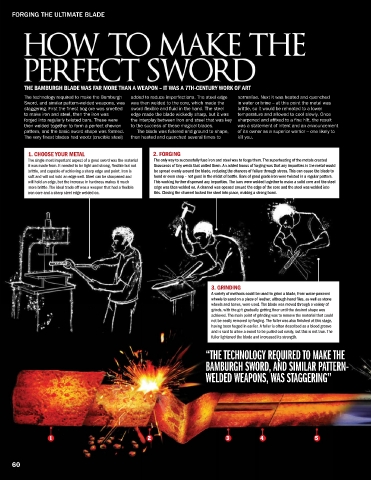
                                                       2. FORGING
                                                       The only way to successfully fuse iron and steel was to forge them. The superheating of the metals created
                                                       thousands of tiny welds that united them. An added bonus of forging was that any impurities in the metal would
                                                       be spread evenly around the blade, reducing the chances of failure through stress. This can cause the blade to
                                                       bend or even snap – not good in the midst of battle. Bars of good grade iron were twisted in a regular pattern.
                                                       This working further dispersed any impurities. The bars were welded together to make a solid core and the steel
                                                       edge was then welded on. A channel was opened around the edge of the core and the steel was welded into
                                                       this. Closing the channel locked the steel into place, making a strong bond.


                                                                           3. GRINDING
                                                                           A variety of methods could be used to grind a blade, from water-powered
                                                                           wheels to sand on a piece of leather, although hand iles, as well as stone
                                                                            h l  d h       d Th bl d    d th  h  i t  f


                                                                         “THETECHNOLOGYREQUIREDTOMAKETHE
                                                                         BAMBURGHSWORD,ANDSIMILARPATTERN-

                                                                         WELDEDWEAPONS,WASSTAGGERING”


                   1                                 2                           3           4                  5


     60

