


Page 61 - History of War - Issue 25-16
P. 61
FORGING THE ULTIMATE BLADE


            “ONCE SHARPENED, THE RESULT WAS A
            STATEMENT OF INTENT AND AN ANNOUNCEMEN
            OF ITS OWNER AS A SUPERIOR WARRIOR–ON

            LIKELY TO KILL YOU”


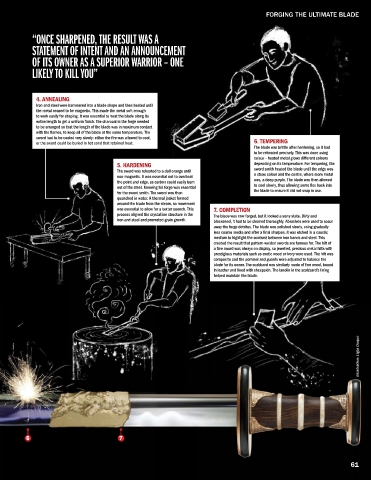
              4. ANNEALING
              Iron and steel were hammered into a blade shape and then heated until
              the metal ceased to be magnetic. This made the metal soft enough
              to work easily for shaping. It was essential to heat the blade along its
              entire length to get a uniform i nish. The charcoal in the forge needed
              to be arranged so that the length of the blade was in maximum contact
              with the l ames, to keep all of the blade at the same temperature. The
              sword had to be cooled very slowly: either the i re was allowed to cool,
                                                                                          6. TEMPERING
                                                                                          The blade was brittle after hardening, so it had
                                                                                          to be reheated precisely. This was done using
                                                                                          colour – heated metal glows different colours
                                          5. HARDENING                                    depending on its temperature. For tempering, the
                                          The sword was reheated to a dull orange until   sword smith heated the blade until the edge was
                                                                                          a straw colour and the centre, where more metal
                                          non-magnetic. It was essential not to overheat
                                          the point and edge, as carbon could easily burn   was, a deep purple. The blade was then allowed
                                                                                          to cool slowly, thus allowing some lex back into
                                          out of the steel. Knowing his forge was essential
                                          for the sword smith. The sword was then         the blade to ensure it did not snap in use.
                                          quenched in water. A thermal jacket formed
                                          around the blade from the steam, so movement
                                          was essential to allow for a better quench. This   7. COMPLETION
                                          process aligned the crystalline structure in the   The blade was now forged, but it looked a sorry state. Dirty and
                                          iron and steel and promoted grain growth.   blackened, it had to be cleaned thoroughly. Abrasives were used to scour
                                                                            away the forge detritus. The blade was polished slowly, using gradually
                                                                            less coarse media and after a i nal sharpen, it was etched in a caustic
                                                                            medium to highlight the contrast between iron bands and steel. This
                                                                            created the result that pattern-welded swords are famous for. The hilt of
                                                                            a i ne sword was always on display, so jewelled, precious metal hilts with
                                                                            prestigious materials such as exotic wood or ivory were used. The hilt was
                                                                            composite and the pommel and guards were adjusted to balance the
                                                                            blade for its owner. The scabbard was similarly made of i ne wood, bound
                                                                            in leather and lined with sheepskin. The lanolin in the scabbard’s lining
                                                                            helped maintain the blade.


          6                                7


                                                                                                                            61

