


Page 62 - History of War - Issue 25-16
P. 62
FORGING THE ULTIMATE BLADE


          THE KATAN


          HOW THE LEGENDARY SAMURAI SWORD GAINED ITS EDGE

          Extraordinary stories have been  (hamon). A perfect hamon was
          attached to these single-edged,  – and is – a sign of an excellent
          curved blades, from the blood  blade, acting as a mark of quality.
          thirst of Muramasa’s swords to the  The forged sword was then
          holy swords of master bladesmith  passed to the polisher who
          Masamune, which would only harm  cleaned and polished the blades
          that which was evil.        using decreasingly abrasive water
           As the pattern-welded blade  stones. This polishing could take
          was rising to prominence and then  weeks and is itself still a ine art
          being replaced by mass-produced  to master.
          inferior blades in Europe, a similar  The inished blade was then
          technique was rising in Japan. The  sent for a inely decorated handle
          technology was startlingly similar,  and scabbard. The inest Japanese
          yet very different. The tatara, a  swords were made by a group of
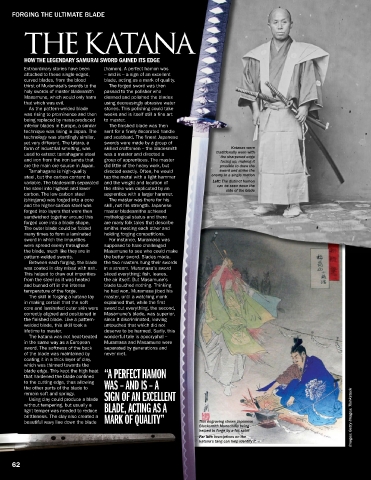
          form of industrial smelting, was  skilled craftsmen – the bladesmith    Katanas were
                                                                             traditionally worn with
          used to extract tamahagane steel  was a master and directed a
                                                                               the sharpened edge
          and iron from the iron sands that  group of apprentices. The master  facing up, making it
          are the main ore source in Japan.  did little of the heavy work, but  possible to draw the
           Tamahagane is high-quality  directed exactly. Often, he would      sword and strike the
                                                                           enemy in a single motion
          steel, but the carbon content is  tap the metal with a light hammer
          variable. The bladesmith separated  and the weight and location of  Left: The distinct hamon
                                                                             can be seen down the
          the steel into highest and lower  the strike was duplicated by an
                                                                                side of the blade
          carbon. The low-carbon steel  apprentice with a larger hammer.
          (shingane) was forged into a core  The master was there for his
          and the higher-carbon steel was  skill, not his strength. Japanese
          forged into layers that were then  master bladesmiths achieved
          sandwiched together around this  mythological status and there
          forged core into a blade shape.  are many folk tales that describe
          The outer blade could be folded  smiths meeting each other and
          many times to form a laminated  holding forging competitions.
          sword in which the impurities  For instance, Muramasa was
          were spread evenly throughout  supposed to have challenged
          the blade, much like they are in  Masamune to see who could make
          pattern-welded swords.      the better sword. Blades made,
           Between each forging, the blade  the two masters hung their swords
          was coated in clay mixed with ash.  in a stream. Muramasa’s sword
          This helped to draw out impurities  sliced everything: ish, leaves,
          from the steel as it was heated  the air itself. But Masamune’s
          and burned off in the intense  blade touched nothing. Thinking
          temperature of the forge.   he had won, Muramasa jibed his
           The skill in forging a katana lay  master, until a watching monk
          in making certain that the soft  explained that, while the irst
          core and laminated outer skin were  sword cut everything, the second,
          correctly aligned and positioned in  Masamune’s blade, was superior,
          the inished blade. Like a pattern-  since it discriminated, leaving
          welded blade, this skill took a  untouched that which did not
          lifetime to master.         deserve to be harmed. Sadly, this
           The katana was not heat-treated  wonderful tale is apocryphal –
          in the same way as a European  Muramasa and Masamune were
          sword. The softness of the back  separated by generations and
          of the blade was maintained by  never met.
          coating it in a thick layer of clay,
          which was thinned towards the
          that hardened the blade conined “APERFECTHAMON
          blade edge. This kept the high heat
          to the cutting edge, thus allowing  WAS–ANDIS–A
          the other parts of the blade to
           Using clay could produce a blade SIGNOFANEXCELLENT
          remain soft and springy.
          light temper was needed to reduce BLADE,ACTINGASA
          without tempering, but usually a
          beautiful wavy line down the blade MARKOFQUALITY”            This engraving shows Japanese                         Images: Getty Images; Thinkstock
          brittleness. The clay also created a
                                                                       Blacksmith Munechika being
                                                                       helped to forge by a fox spirit
                                                                       Far left: Inscriptions on the
                                                                       katana’s tang can help identify it


     62

