


Page 71 - History of War - Issue 25-16
P. 71
YOM KIPPUR WAR
that gave them time to bring up reinforcements
that would turn the tide.
When Israel was at its most desperate, its
defence ministry began mulling over the option
of using its nuclear arsenal as a last resort,
but pressed the US for a resupply. Kissinger
realised a defeat at the hands of Soviet-backed
Arab states would be a geopolitical nightmare,
so the US launched Operation Nickel Grass
to airlift weapons to the Israelis. In total the
US brought Israel more than $2.2 billion in
additional emergency military aid.
In response, and following an Israeli violation
of an agreed ceasei re when its forces pressed
on in Egypt, Soviet premiere Leonid Brezhnev
threatened to put Soviet troops in the region.
The Soviets began a resupply of Syria and
Egypt, and the world found itself in a Cold War
standoff that had the potential to escalate into
a thermonuclear conl ict. US troops were put on
high alert. When the conl ict concluded, the US
used a complete return of the Sinai peninsula
as political leverage to switch Egypt to the USA,
rather than Soviet aid.
National attitudes
The Yom Kippur War wasn’t to be decided
on the merits of technology alone – public
attitudes towards the conl ict, on all sides
of the conl ict, heavily inl uenced how each
belligerent fought. This was true previously in
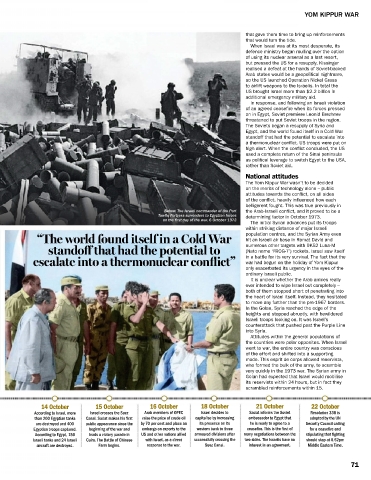
Below: The Israeli commander of the Port the Arab-Israeli conl ict, and it proved to be a
Tawi q Fortress surrenders to Egyptian forces determining factor in October 1973.
on the i rst day of the war, 6 October 1973
The initial Syrian advances put its troops
within striking distance of major Israeli
“The world found itself in a Cold War population centres, and the Syrian Army even
hit an Israeli air base in Ramat David and
standof that had the potential to numerous other targets with 9K52 Luna-M
(Nato name ‘FROG-7’) rockets. Israel saw itself
escalate into a thermonuclear con ict” in a battle for its very survival. The fact that the
war had begun on the holiday of Yom Kippur
only exacerbated its urgency in the eyes of the
ordinary Israeli public.
It is unclear whether the Arab armies really
ever intended to wipe Israel out completely –
both of them stopped short of penetrating into
the heart of Israel itself. Instead, they hesitated
to move any further than the pre-1967 borders.
In the Golan, Syria reached the edge of the
heights and stopped abruptly, with bewildered
Israeli troops looking on. It was Israel’s
counterattack that pushed past the Purple Line
into Syria.
Attitudes within the general populations of
the countries were polar opposites. When Israel
went to war, the entire country was conscious
of the effort and shifted into a supporting
mode. This esprit de corps allowed reservists,
who formed the bulk of the army, to scramble
very quickly in the 1973 war. The Syrian army in
Golan had expected that Israel would mobilise
its reservists within 24 hours, but in fact they
scrambled reinforcements within 15.
14 October 15 October 16 October 18 October 21 October 22 October
According to Israel, more Israel crosses the Suez Arab members of OPEC Israel decides to Sadat informs the Soviet Resolution 338 is
than 200 Egyptian tanks Canal. Sadat makes his i rst raise the price of crude oil capitalise by increasing ambassador to Egypt that adopted by the UN
are destroyed and 400 public appearance since the by 70 per cent and place an its presence on its he is ready to agree to a Security Council calling
Egyptian troops captured. beginning of the war and embargo on exports to the western bank to three ceasei re. This is the i rst of for a ceasei re and
According to Egypt, 150 leads a victory parade in US and other nations allied armoured divisions after many negotiations between the stipulating that i ghting
Israeli tanks and 24 Israeli Cairo. The Battle of Chinese with Israel, as a direct successfully crossing the two sides. The Israelis have no should stop at 6.52pm
aircraft are destroyed. Farm begins. response to the war. Suez Canal. interest in an agreement. Middle Eastern Time.
71

