


Page 76 - History of War - Issue 25-16
P. 76
THE NEW MODEL


          but remembered by history  as  the  ‘Ironsides’.  was to have 22,000 men in which there would
          This force was at irst composed of determined   be 12 regiments of foot – 1,200 men in each
          Puritan farmers, deliberately chosen for their   section. Each regiment would contain two-thirds
          strict religious resolve. Cromwell’s training   musketeers and one-third pikemen. Additionally,
          of his Ironsides made him stand out against   there would be 11 cavalry regiments, one
          other commanders, particularly his Royalist   regiment of dragoons and an artillery train of
          counterparts. He followed the common practice   50 guns. The highly experienced Sir Thomas
          of arranging his cavalry in three ranks, while   Fairfax would command the army and Philip
          leading them forward for impact rather than   Skippon the infantry.
          irepower. However, he also encouraged his   In April 1645, Cromwell forced through the
          troops to charge in close formation, riding  ‘Self-Denying Ordinance’ bill, preventing MPs in
          knee-to-knee – a tactic  already familiar in  the House of Lords and Commons from holding
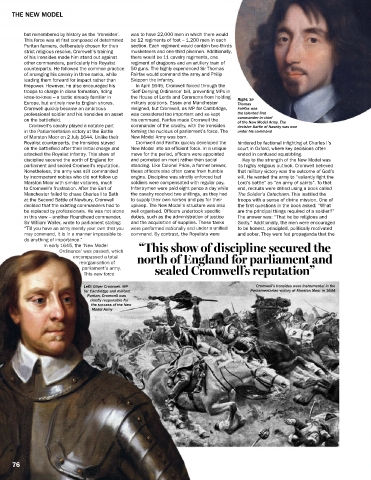
                                                                                     Right: Sir
          Europe, but entirely new to English shores.  military positions. Essex and Manchester  Thomas
          Cromwell quickly became an ambitious  resigned, but Cromwell, as MP for Cambridge,  Fairfax was
          professional soldier and his Ironsides an asset  was considered too important and so kept  the talented i rst
                                                                                     commander-in-chief
          on the battleield.                   his command. Fairfax made Cromwell the
                                                                                     of the New Model Army. The
           Cromwell’s cavalry played a notable part  commander of the cavalry, with the Ironsides  decisive Battle of Naseby was won
          in the Parliamentarian victory at the Battle  forming the nucleus of parliament’s force. The  under his command
          of Marston Moor on 2 July 1644. Unlike their  New Model Army was born.
          Royalist counterparts, the Ironsides stayed  Cromwell and Fairfax quickly developed the  hindered by factional ini ghting at Charles I’s
          on the battleield after  their initial charge and  New Model into an eficient force. In a unique  court in Oxford, where key decisions often
          attacked the Royalist infantry. This show of  move for the period, oficers were appointed  ended in confused squabbling.
          discipline secured the north of England for  and promoted on merit rather than social  Key to the strength of the New Model was
          parliament and sealed Cromwell’s reputation.  standing. Like Colonel Pride, a former brewer,  its highly religious outlook. Cromwell believed
          Nonetheless, the army was still commanded  these oficers also often came from humble  that military victory was the outcome of God’s
          by incompetent nobles who did not follow up  origins. Discipline was strictly enforced but  will. He wanted the army to “valiantly i ght the
          Marston Moor with similar victories, much  soldiers were compensated with regular pay.  Lord’s battle” as “an army of saints”. To that
          to Cromwell’s frustration. After the Earl of  Infantrymen were paid eight pence a day while  end, recruits were drilled using a book called
          Manchester failed to chase Charles I to Bath  the cavalry received two shillings, as they had  The Soldier’s Catechism. This instilled the
          at the Second Battle of  Newbury, Cromwell  to supply their own horses and pay for their  troops with a sense of divine mission. One of
          decided that the existing commanders had to  upkeep. The New Model’s structure was also  the i rst questions in the book asked: “What
          be replaced by professionals. He was not alone  well organised. Oficers undertook speciic  are the principal things required of a soldier?”
          in this view – another Roundhead commander,  duties, such as the administration of justice  The answer was: “That he be religious and
          Sir William Waller, wrote to parliament stating:  and the acquisition of supplies. These tasks  Godly.” Additionally, the men were encouraged
          “Till  h            l        h                         ll   under a uniied  to be honest, principled, politically motivated
                                                                     yalists were    and sober. They were fed propaganda that the
                                                  “This show of discipline secured the

                                                 north of England for parliament and
                                                       sealed Cromwell’s reputation”


                              Left: Oliver Cromwell. MP                                    Cromwell’s Ironsides were instrumental in the
                              for Cambridge and militant                                 Parliamentarian victory at Marston Moor in 1644
                                Puritan. Cromwell was
                                 chiel y responsible for
                                 the success of the New
                                 Model Army


     76

