


Page 72 - History of War - Issue 25-16
P. 72
BRIEFING


           Israel was well aware of its perception in the
          international community’s eye. As the Israeli
          cabinet discussed the future of its operations
          in Golan, Israeli prime minister Golda Meir
          insisted that the army press into Syria’s Bashan
          region. If the war had ended as the Israelis
          began to shift a division to the Sinai front,
          which could have taken as long as four days,
          then Israel would have suffered a territorial loss
          in the south and no gain in the north, which
          would have been perceived as a defeat.
           At the conclusion of the war, Meir spoke
          in front of the Israeli Knesset and said: “The
          war in which we are engaged began with a
          concerted attack on two fronts. The aggressive
          initiative afforded our enemies preliminary
          achievements – but, thanks to the spirit and
          strength of Israel’s Defense Army, which is
          backed by the entire nation, the attack was
          broken. The aggressors were thrown back.
          Considerable portions of their forces were
          destroyed, and the IDF broke through and
          crossed the ceasei re lines. From holding
          battles our forces went on to the offensive and
          gained brilliant achievements.”
           The Arab neighbours were also well aware of
          their own perception. They had begun the war
          in an attempt to restore not only lost territory
          but also their dignity in the public eye after the
          humiliating defeats of the 1967 war.
           In Damascus and Cairo, however, it was the
          military class that went to war. Civilians mostly
          continued on with their daily lives and normal
          routines. Information was slow to reach them
          through heavily monitored media outlets, and
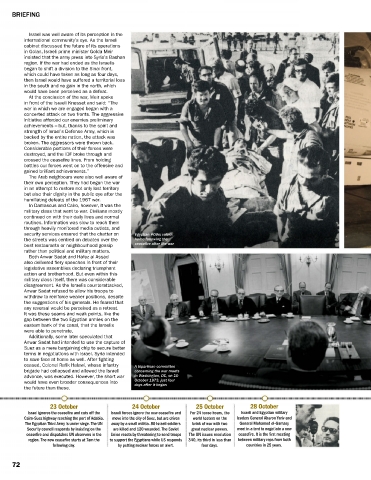
          security services ensured that the chatter on  Egyptian POWs return
          the streets was centred on debates over the  home following the
          best restaurants or neighbourhood gossip  ceasei re after the war
          rather than political and military matters.
           Both Anwar Sadat and Hafez al Assad
          also delivered iery speeches in front of their
          legislative assemblies declaring triumphant
          action and brotherhood. But even within this
          military class itself, there was considerable
          disagreement. As the Israelis counterattacked,
          Anwar Sadat refused to allow his troops to
          withdraw to reinforce weaker positions, despite
          the suggestions of his generals. He feared that
          any reversal would be perceived as a retreat.
          It was these seams and weak points, like the
          gap between the two Egyptian armies on the
          eastern bank of the canal, that the Israelis
          were able to penetrate.
           Additionally, some later speculated that
          Anwar Sadat had intended to use the capture of
          Suez as a mere bargaining chip to secure better
          terms in negotiations with Israel. Syria intended
          to save face at home as well. After ighting
          ceased, Colonel Raik Halawi, whose infantry  A bipartisan committee
          brigade had collapsed and allowed the Israeli  concerning the war meets
          advance, was executed. However, the short war  in Washington, DC, on 10
                                                October 1973, just four
          would have even broader consequences into
                                                days after it began
          the future than these.
                   23 October                  24 October             25 October         28 October
           Israel ignores the ceasei re and cuts off the   Israeli forces ignore the new ceasei re and   For 24 tense hours, the   Israeli and Egyptian military
          Cairo-Suez highway reaching the port of Adabia.   move into the city of Suez, but are driven   world teeters on the   leaders General Aharon Yariv and
          The Egyptian Third Army is under siege. The UN   away by a small militia. 80 Israeli soldiers   brink of war with two   General Mohamed el-Gamasy
           Security council responds by insisting on the   are killed and 120 wounded. The Soviet   great nuclear powers.   meet in a tent to negotiate a new
          ceasei re and dispatches UN observers in the   Union reacts by threatening to send troops   The UN issues resolution   ceasei re. It is the i rst meeting
           region. The new ceasei re starts at 7am the   to support the Egyptians while US responds   340, its third in less than   between military reps from both
                    following day.        by putting nuclear forces on alert.  four days.  countries in 25 years.


     72

