


Page 75 - History of War - Issue 25-16
P. 75
CROMWELL’S REBEL ARMY


                  n the 1640s, people of all classes  When Charles I declared war on 22 August  Manchester, whose ield strategy was timid and
                  were embroiled in a grim struggle over  1642, the Royalist and Parliamentarian armies  lethargic. This meant there was no decisive
                  a fundamental question – who was the  were evenly matched – both amateur in attitude  battle for the irst two years of the war. Oliver
                  supreme power in the land, the king  and performance, particularly regarding their  Cromwell observed these circumstances from
            Ior parliament? The British Civil Wars  commanders. On the Royalist side, Prince  the sidelines with frustration, and resolved to
            raged for a decade and became a cataclysmic  Rupert of the Rhine was an experienced soldier  change the situation to parliament’s advantage.
            struggle for England’s soul. It was also a  but also hot-headed and unable to control  Already in his 40s when the war broke out,
            conlict that would engulf Wales, Scotland  the cavalry under his command. During the  and without any military training, Cromwell
            and Ireland with devastating consequences.  irst major battle of the war, at Edgehill on 23  was an unexpected innovator determined to
            The resulting chaos saw the execution of a  October 1642, the Royalists nearly won the  reorganise parliament’s army. His personal
            king and the establishment of a republican  day having broken through the Roundhead  strength stemmed from his religious fervour.
            Commonwealth. Two things were largely  lines with a cavalry charge. However, this  In an age where religion dictated everything,
                  responsible for making this radical  breakthrough was not properly followed up  Cromwell was a zealot, seeing the hand of
                  change possible. One was an obscurely  as Rupert’s cavalry charged away from the  God in everything. This enabled him to be a
                  born MP from Huntingdon called Oliver  battleield to loot nearby villages – the end  supremely conident commander who was
                  Cromwell; the other was the most  result was stalemate. Similarly, Parliamentarian  willing to take risks. In 1643, he formed his
                  innovative military force of the age – the  forces were at irst commanded by ineffectual  own cavalry regiment in Huntingdon, initially
                  New Model Army.                 aristocrats such as the Earls of Essex and  known as the Army of the Eastern Association

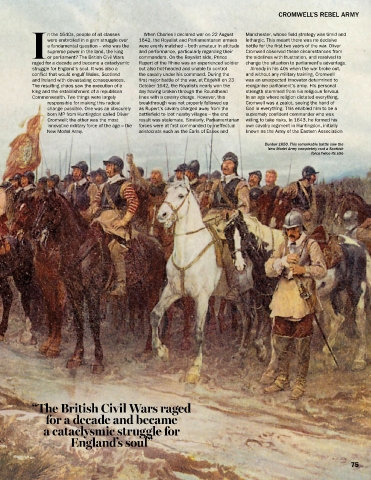
                                                                                              Dunbar 1650. This remarkable battle saw the
                                                                                               New Model Army completely rout a Scottish
                                                                                                              force twice its size


            “The British Civil Wars raged

                 for a decade and became
                a cataclysmic struggle for

                          England’s soul”


                                                                                                                            75

