


Page 79 - History of War - Issue 25-16
P. 79
CROMWELL’S REBEL ARMY


                                                      WINNING TACTICS


                                                                 AT          DUNBAR


                                                   A tired and hungry New Model Army triumphed against the odds with
                                                       the help of daring leadership and some rousing hymn singing

                                                   The Battle of Dunbar was arguably Cromwell’s   the fatigued New Model Army started to retire to
                                                   greatest victory. He had invaded Scotland with a   their supply base at Dunbar. However, the Scots
                                                   veteran army of 15,000 men (10,000 foot and   got there i rst and blocked their path, positioning
                                                   5,000 horse) to pre-empt an invasion of England  themselves on Doon Hill overlooking the Berwick
                                                   by Charles II. His army was supplied from the   road  –  the  only route back to England.
                                                   sea on the east coast of Scotland as the Scots   The Scots were also numerically superior, some
                                                   had adopted a scorched-earth policy between   22,000 men, and ighting on home territory. With
                                                   Edinburgh and the border. By September 1650,   some of his men suffering from illness, Cromwell
                                                                                       was outnumbered almost two to one and with battle
                                                                                       now the only option, even he acknowledged that the
                                                                                       situation  had turned desperate: “We are upon an
                                                                                       engagement very dificult… the enemy hath blocked
                                                                                       up our way… through which we cannot get without
                                                                                       almost a miracle.”
                                                                                         To add to Cromwell’s misery, the Scots were
                                                                                       commanded by David Leslie, a highly experienced
                                                                                       soldier. Leslie and Cromwell had fought together
                                                                                       at Marston Moor where the former had played
                                                                                       an important part in the Parliamentarian victory.
                                                                                       However, on 2 September, under pressure from the
                                                                                       Scottish Kirk and parliament to attack, Leslie moved
                                                                                       down from his commanding position on Doon Hill
                                                                                       and  towards  Dunbar town to launch an attack on the
                                                                                       English encampment. Cromwell immediately saw
                                                                                       this mistake and decided to meet the challenge the
                                                                                       next day, 3 September.
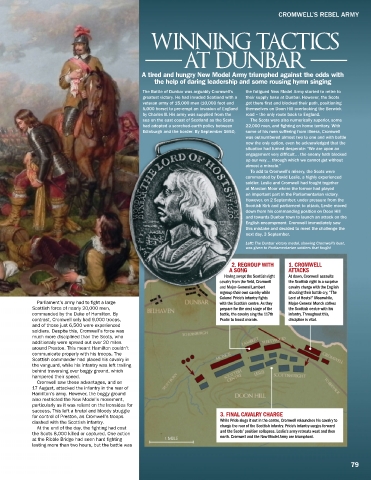
                                                                                       Left: The Dunbar victory medal, showing Cromwell’s bust,
                                                                                       was given to Parliamentarian soldiers that fought

                                                                                      EGROUP WITH     1. CROMWELL
                                                                                       G              ATTACKS
                                                                                      pt the Scottish right  At dawn, Cromwell assaults
                                                                                      he i eld, Cromwell  the Scottish right in a surprise
                                                                                      neral Lambert   cavalry charge with the English
                                                                              regroup their own cavalry while   shouting their battle cry, “The
                                                                              Colonel Pride’s infantry i ghts   Lord of Hosts!” Meanwhile,
              Parliament’s army had to i ght a large                          with the Scottish centre. As they  Major-General Monck strikes
            Scottish force of nearly 20,000 men,                              prepare for the next stage of the  the Scottish centre with his
            commanded by the Duke of Hamilton. By                             battle, the cavalry sing the 117th  infantry. Throughout this,
            contrast, Cromwell only had 9,000 troops,                         Psalm to boost morale.   discipline is vital.
            and of those just 6,500 were experienced
            soldiers. Despite this, Cromwell’s force was
            much more disciplined than the Scots, who
            additionally were spread out over 20 miles
            around Preston. This meant Hamilton couldn’t
            communicate properly with his troops. The
            Scottish commander had placed his cavalry in
            the vanguard, while his infantry was left trailing
            behind traversing over boggy ground, which
            hampered their speed.
              Cromwell saw these advantages, and on
            17 August, attacked the infantry in the rear of
            Hamilton’s army. However, the boggy ground
            also restricted the New Model’s movement,
            particularly as it was reliant on the Ironsides for
            success. This left a brutal and bloody struggle                   3. FINAL CAVALRY CHARGE
            for control of Preston, as Cromwell’s troops
            clashed with the Scottish infantry.                               While Pride slugs it out in the centre, Cromwell relaunches his cavalry to
                                                                              charge the rear of the Scottish infantry. Pride’s infantry surges forward
              At the end of the day, the i ghting had cost
            the Scots 8,000 killed or captured. One action                    and the Scots’ position collapses. Leslie’s army retreats west and then
                                                                              north. Cromwell and the New Model Army are triumphant.
            at the Ribble Bridge had seen hard i ghting    1 MILE
            lasting more than two hours, but the battle was

                                                                                                                            79

