


Page 81 - History of War - Issue 25-16
P. 81
CROMWELL’S REBEL ARMY


            not yet won and it continued again the following   “Despite the seemingly unstoppable
            day. Cromwell had to invest Preston with a
            strong garrison and guards for the large number   force of the New Model Army in
            of prisoners. He now only had 3,000 infantry
            and 2,500 cavalry to i ght the remaining   Ireland, it was also the only place
            10,000 Scottish troops. Luckily for the English,

            Hamilton was experiencing his own problems   where it sufered a serious beating”
            – his men were exhausted, lumbered with wet
            ammunition, and many of the hungriest had
            gone to Wigan to plunder food. This enabled   What tarnished these successes were the  in 1649-50. The season was unusually mild
            Cromwell to continually harry the Scots as they   massacres of enemy soldiers and civilians.  and the army used this to procure supplies of
            fought a disorganised retreat. Despite making   During the storming of Drogheda, about  fodder for its horses and draught animals. This
            some determined stands at various passes and  3-4,000 soldiers and civilians were killed,  allowed Cromwell to renew operations at the
            bridges, Hamilton’s army could not withstand   many of them in cold blood. Likewise at  end of January 1650, rather than having to wait
            the disciplined onslaughts from the Ironsides,   Wexford a similar number of Irish soldiers and  for the spring.
            and eventually what was left of the troops   civilians were dispatched. In both sieges, the  Despite  the seemingly unstoppable force of
            offered their surrender.              massacres occurred when New Model troops  the New Model Army in Ireland, it was also the
              Once again the New Model Army had   went on a frenzied rampage after the towns  only  place  where it suffered a serious beating.
            l attened Royalist hopes of victory, and this   were stormed. In 17th-century Europe atrocities  At  the  Siege of Clonmel in May 1650, Cromwell
            time parliament no longer accommodated   such as this were tragically common.  attempted his usual tactic of storming the
            the king. He was put on trial for treason   However horriic the massacres were,  town after an artillery bombardment. However,
            against his own people, found guilty and   they did serve a purpose. Many Irish towns  unknown to the army, the breach was internally
            publicly beheaded in Whitehall on 30 January   subsequently surrendered to Cromwell out  surrounded with an enclosed area that was
            1649. Cromwell was one of the signatories   of fear, not just of the New Model’s military  i lled with Irish cannon and musketeers.
            to his execution and England was declared a   prowess but also to prevent further loss of  Two assaults by New Model troops ended
            republican Commonwealth with the New Model   life. This saved Cromwell time and supplies in  in disaster. On both occasions, the English
            Army acting as the enforcer of this new state.   conducting drawn-out sieges. He also showed  became trapped and eventually 1,500-2,500
            Fairfax resigned his army command in protest   strategic foresight over the following winter  soldiers were killed. This was the New Model’s
            against the king’s death and Cromwell became
            commander-in-chief of the army.
              Many others were also outraged by Charles’s
            execution, particularly the Royalists and the   REVOLUTIONARY
            Scots who had not been consulted about their
            monarch’s fate. This anger found an outlet in
            Ireland, where English Royalists formed an                      ARMS
            alliance with Irish Catholic Confederates and
            Ulster Scots against the Commonwealth. So,
            in March 1649, parliament commissioned   The New Model was a hive of political dissent calling for democratic
            Cromwell to invade Ireland with the New Model   rights 150 years before the American and French Revolutions
            Army. Leaving nothing to chance, he made sure
            the men, including some 12,000 veterans,   The meritocratic nature of the army
            were fully paid and equipped before setting   encouraged grassroots political activity
            sail. His Irish campaign would be of a different   that was unprecedented and strikingly
            nature to the ones that came before and after.   forward thinking. Common soldiers known
            Instead of decisive battles, the army would   as ‘Agitators’ were elected in 1647 to
            engage in a series of sieges that would whittle   demand unpaid wages from parliament,
            down Irish resistance.                  but when this was refused, they arrested
              For Cromwell, it would be a militarily brilliant   the imprisoned Charles I to use him
            campaign, but also one marred by controversy.   as a bargaining tool against the army
            His tactics centred around massive artillery   ‘Grandees’ such as Cromwell. By this
            bombardments of fortii ed towns and speedy   time, Agitators were co-operating with
            marches to surprise neighbouring garrisons. To   Levellers – who believed in an extended
            save time and men, he would issue generous   franchise, individual rights enshrined in
            surrender terms, but if the garrison refused   a written constitution and a government
            to comply, he used shock tactics to persuade   answerable to the people, not the king.
            others that capitulation was the best option   Cromwell agreed to discuss the issues
            against the advancing force.            at the Putney Debates in October 1647,
              The most notorious of these incidents occurred   where many soldiers passionately argued
            at the Sieges of Drogheda and Wexford, though   for universal democratic rights. Colonel
            militarily both these were notable successes   Rainsborough famously declared: “I think
            for Cromwell. At Drogheda, artillery was used   that the poorest he that is in England hath
            to concentrate i repower into the breaches and   a life to live, as the greatest he. I think it’s
            Cromwell personally rallied his troops by leading   clear that every man that is to live under a
            them into the fray. Parliamentarian casualties   government ought irst by his own consent
            were low, numbering about 150 men. Similarly   to put himself under that government.” The
            at Wexford, Cromwell skilfully manoeuvred   Grandees rejected many of these demands,
            around the port and approached it from the   which fuelled further discontent. In 1649,
            south. This took the garrison by surprise as they   Leveller mutinies broke out in the army and
            were expecting the army to approach from the   were brutally crushed. The radical ideas
            north. The town was quickly taken and the army   that were espoused by the army rebels
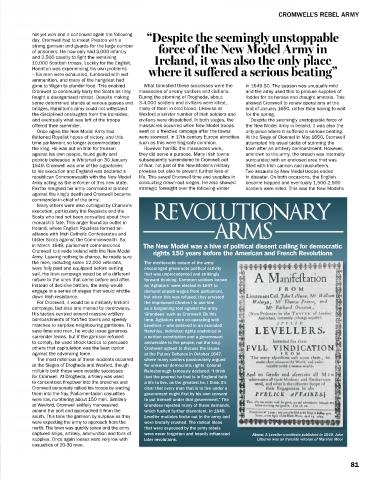
            captured ships, artillery, ammunition and tons of   were never forgotten and heavily inluenced  Above: A Leveller manifesto published in 1649. John
            supplies. Once again losses were very low with   later revolutions.            Lilburne was an Ironside veteran of Marston Moor
            casualties of 20-30 men.


                                                                                                                            81

