


Page 82 - History of War - Issue 25-16
P. 82
THE NEW MODEL


          irst major setback and its greatest loss of life  Leslie, the defeated commander at Dunbar.   order to carry out the battle plan, so Cromwell
          sustained in a single action. Nonetheless, the  In August 1651, 14,000 Scottish troops   began the ight by personally leading three
          Irish had also suffered and abandoned the town  crossed the border. Cromwell, who was still   brigades to attack the pontoon bridge on the
          having lost several hundred men.     reducing Scotland, followed Charles and   River Teme. Once the north bank had been
           Cromwell left Ireland soon afterwards but  collected reinforcements as he proceeded   taken, the Scots collapsed back towards
          his remaining troops carried on the systematic  south. The New Model Army caught up   Worcester itself. While Cromwell was crossing
          conquest of the country, with the whole island  with the invading army at Worcester on 3   the rivers, the east lank of his army was
          eventually being subjugated.         September. By this time, Cromwell’s force   threatened when Charles II rallied his troops
           After many negotiations, Charles II sailed  numbered 28,000 regular troops and 3,000   to sally out of the town and assault the New
          to Scotland and was proclaimed king.  militiamen. This was the irst occasion when   Model infantry. This surprise attack was initially
          This presented a genuine threat to the  the New Model Army had overwhelming   successful and there was a moment when the
          Commonwealth and Cromwell subsequently  numerical superiority over the enemy and   entire east wing of the army almost collapsed.
          invaded Scotland to prevent a Scottish invasion  Cromwell was at the peak of his conidence.   However, Cromwell came charging back from
          into England. After the miraculous New Model  The Battle of Worcester took place in a wide   his position on the River Severn to bolster his
          victory at Dunbar in September 1650, the  area around the city. Cromwell attempted to   troops. The return of his brigades turned the
          Royalist cause looked lost. Nonetheless,  encircle Worcester in order to force Charles into  tide of the battle and the Royalists were thrown
          Charles II was crowned king of Scots on 1  a defensive position within its walls. However,   back into Worcester.
          January 1651, and later in the year he led a  to the south and south west of Worcester, the   At this point, parliament’s Essex militia
          last-ditch invasion of England to regain his  Rivers Severn and Teme blocked the army’s   stormed and captured Fort Royal, which was a
          throne. This was against the advice of David  advance. These would need to be crossed in   defensive entrance into the city. Once the guns

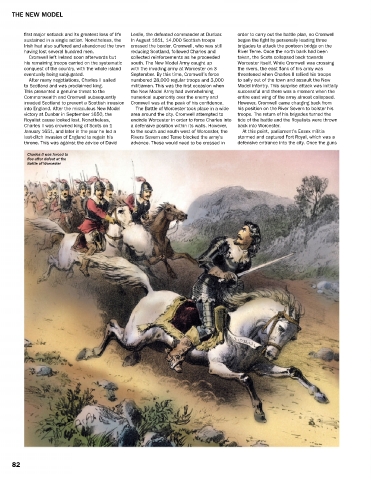
           Charles II was forced to
           lee after defeat at the
           Battle of Worcester


     82

