


Page 86 - History of War - Issue 25-16
P. 86
Operator’s Handbook


                                       Europe’s multi-role workhorse has stood the test of
         PANAVIA time to serve in more than i ve decades of combat
                                                                        AD


             WORDS & IMAGES NEILL WATSON


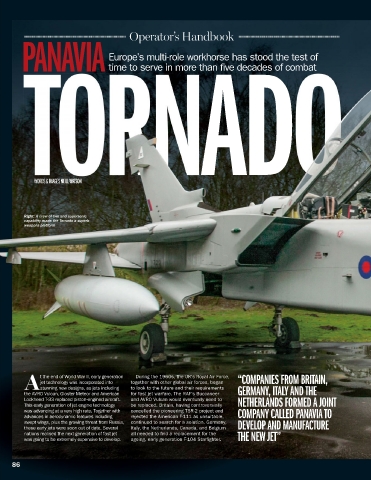
          Right: A crew of two and supersonic
          capability made the Tornado a superb
          weapons platform


                                                 During the 1960s, the UK’s Royal Air Force,
               t the end of World War II, early generation   together with other global air forces, began  “COMPANIES FROM BRITAIN,
               jet technology was incorporated into
          Astunning new designs, as jets including   to look to the future and their requirements   GERMANY, ITALY AND THE
          the AVRO Vulcan, Gloster Meteor and American   for fast jet warfare. The RAF’s Buccaneer
          Lockheed T-33 replaced piston-engined aircraft.   and AVRO Vulcan would eventually need to   NETHERLANDS FORMED A JOINT
          This early generation of jet engine technology   be replaced. Britain, having controversially
          was advancing at a very high rate. Together with   rejected the American F-111 as unsuitable,  COMPANY CALLED PANAVIA TO
                                               cancelled the pioneering TSR-2 project and
          advances in aerodynamic features including
          swept wings, plus the growing threat from Russia,   Italy, the Netherlands, Canada, and Belgium  DEVELOP AND MANUFACTURE
                                               continued to search for a solution. Germany,
          these early jets were soon out of date. Several
          nations realised the next generation of fast jet   all needed to i nd a replacement for the   THE NEW JET”
          was going to be extremely expensive to develop.   ageing, early generation F-104 Stari ghter.

