


Page 53 - BBC Wildlife Volume 36 #12
P. 53
WILDNEWS                                                                                                             By    BARANIUK

                                                                                                                                       STUART BLACKMAN,
                                                                                                                                       JAMES FAIR, NIKI RUST,
                                                                                                                                       KRISTEN GILL, KENNY
                                                                                                                                       TAYLOR, SIMON BIRCH,
                                                                                                                                       CHRIS


                      KEEPING             YOU        UP     TO     DATE        WITH HE               BIG      NATURE             STORIES
                                                                                           T


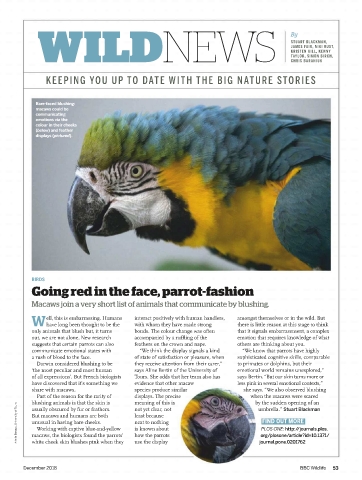
                  Bare-faced blushing:
                  macaws could be
                  communicating
                  emotions via the
                  colour in their cheeks
                  (below) and feather
                  displays (pictured).


                BIRDS
                Goingredintheface,parrot-fashion


                Macaws join a very short list of animals that communicate by blushing.


                      ell, this is embarrassing. Humans        interact positively with human handlers,        amongst themselves or in the wild. But
                Whave long been thought to be the              with whom they have made strong                 there is little reason at this stage to think
                only animals that blush but, it turns          bonds. The colour change was often              that it signals embarrassment, a complex
                out, we are not alone. New research            accompanied by a ruffling of the                 emotion that requires knowledge of what
                suggests that certain parrots can also         feathers on the crown and nape.                 others are thinking about you.
                communicate emotional states with                “We think the display signals a kind            “We know that parrots have highly
                a rush of blood to the face.                   of state of satisfaction or pleasure, when      sophisticated cognitive skills, comparable
                  Darwin considered blushing to be             they receive attention from their carer,”       to primates or dolphins, but their
                ‘the most peculiar and most human              says Aline Bertin of the University of          emotional world remains unexplored,”
                of all expressions’. But French biologists     Tours. She adds that her team also has          says Bertin. “But our skin turns more or
                have discovered that it’s something we         evidence that other macaw                       less pink in several emotional contexts,”
                share with macaws.                             species produce similar                           she says. “We also observed blushing
                  Part of the reason for the rarity of         displays. The precise                                 when the macaws were scared
                                                               meaning of this is
                                                                                                                       by the sudden opening of an
                blushing animals is that the skin is
         Arielle Beraud, University of Tours  But macaws and humans are both  least because                              journal.pone.0201762
                usually obscured by fur or feathers.
                                                               not yet clear, not
                                                                                                                        umbrella.” Stuart Blackman
                                                                                                                          FIND OUT MORE
                                                               next to nothing
                unusual in having bare cheeks.
                  Working with captive blue-and-yellow
                                                               is known about
                                                                                                                         PLOS ONE: http://journals.plos.
                macaws, the biologists found the parrots’
                                                               how the parrots
                                                                                                                         org/plosone/article?id=10.1371/
                white cheek skin blushes pink when they
                                                               use the display
            December 2018                                                                                                                  BBC Wildlife    53

