


Page 58 - BBC Wildlife Volume 36 #12
P. 58
WILDNEWS


                  DISCOVERY

                 Prehistoric Irish elk skull

                 found by ishermen


                        hen he first saw it, fisherman
                 WCharlie Coyle thought he was
                 looking at the devil. “Throw it back
                 in!” he said to boat mate, Raymond
                 McElroy. But it wasn’t the devil, it was
                 the fantastically well-preserved skull and
                 antlers of an Irish elk, a species that died
                 out in Ireland 10,000 years ago. The
                 pair hauled the skull aboard on a recent
                 fishing trip on Lough Neagh, in Northern
                 Ireland. “I’ve been on Lough Neagh
                 45 years and I never thought I’d find
                 something that historical.” says Coyle.
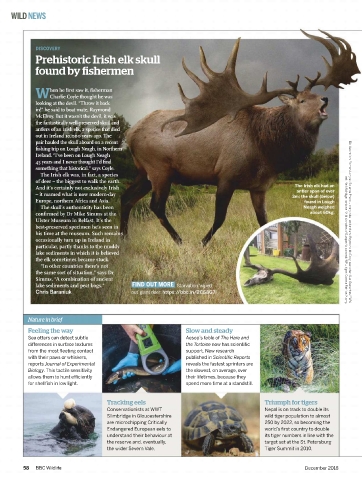
                    The Irish elk was, in fact, a species
                 of deer – the biggest to walk the earth.                                                                                                         Elk illustration: Roman Uchyte /Sc ence Photo L brary; sku
                 And it’s certainly not exclusively Irish                                                                                The Irish elk had an
                                                                                                                                          antler span of over
                 – it roamed what is now modern-day
                                                                                                                                        3m; the skull (below)
                 Europe, northern Africa and Asia.                                                                                           found in Lough
                    The skull’s authenticity has been                                                                                        Neagh weighed
                 confirmed by Dr Mike Simms at the                                                                                               about 60kg.
                 Ulster Museum in Belfast. It’s the
                 best-preserved specimen he’s seen in
                 his time at the museum. Such remains
                 occasionally turn up in Ireland in                                                                                                             eel: Neil Aldridge; tortoise: Wild Wonders of Europe/Widstrand/NPL; tiger: Correia Patrice/Alamy
                 particular, partly thanks to the muddy
                 lake sediments in which it is believed                                                                                                           and ant ers: Raymond McE roy; sea otter: Suz
                 the elk sometimes became stuck.
                    “In other countries there’s not
                 the same sort of situation,” says Dr
                 Simms. “A combination of ancient
                 lake sediments and peat bogs.”               FIND OUT MORE Starvation‘wiped
                 Chris Baraniuk                               out’ giant deer: https://bbc.in/2CS8G7I                                                             Eszterhas/FLPA;


              Nature in brief

              Feeling the way                                                          Slow and steady

              Sea otters can detect subtle                                             Aesop’s fable of The Hare and
              diferences in surface textures                                           the Tortoise now has scientific
              from the most fleeting contact                                            support. New research
              with their paws or whiskers,                                             published in Scientific Reports
              reports Journal of Experimental                                          reveals the fastest sprinters are
              Biology. This tactile sensitivity                                        the slowest, on average, over
              allows them to hunt e ciently                                            their lifetimes, because they
              for shellfish in low light.                                               spend more time at a standstill.


                                                  Tracking eels                                                            Triumph for tigers
                                                  Conservationists at WWT                                                  Nepal is on track to double its
                                                  Slimbridge in Gloucestershire                                            wild tiger population to almost
                                                  are microchipping Critically                                             250 by 2022, so becoming the
                                                  Endangered European eels to                                              world’s first country to double
                                                  understand their behaviour at                                            its tiger numbers in line with the
                                                  the reserve and, eventually,                                             target set at the St. Petersburg
                                                  the wider Severn Vale.                                                   Tiger Summit in 2010.


            58    BBC Wildlife                                                                                                                December 2018

