


Page 55 - BBC Wildlife Volume 36 #12
P. 55
WILDNEWS


               CONSERVATION REPORT                                                         RED LIST
                                                                                            STATUS
                                                                                         VULNERABLE
               Giantmantaray


               Erick Higuera shines a spotlight on the world’s largest
               ray as it returns to the Sea of Cortez.


                Whyisthereturnofgiantmanta                    monitor the effects of conservation
                raystotheSeaofCortezsigniicant?               efforts in the region. We’ve recently
                These beautiful sea creatures, with an        conducted emergency all-hands-on
                                                                                                                 The Wash is
                average wingspan of 6m across and the         meetings, with the goal of aligning
                                                                                                                 England’s biggest
                largest specimens weighing as much as         the local diving tour operators with               SSSI and a vital
                1,350kg, haven’t been seen in the south       the newest rules and regulations                   coastal wetland.
                part of the Baja California Peninsula         regarding how to swim with the mantas
                since 2002 – possibly due to the threat       and how to teach their clients these             ENVIRONMENT
                of bycatch and overfishing encountered         best practices. It is important to keep
                by the small population of around 50          these giants living wild and free in the         Concern for sites of
                individuals. The new sightings of 15          hope that they will return to the Baja
                different juvenile manta rays in the          Peninsula for years to come.                     scientiic interest
                summer of 2018 might be an indicator
                of a possible nursery, which is why their     Howhastechnologyhelped                                he Government’s under-fire wildlife
                return is so important.                       withconservationeforts?                          Tagency Natural England has come
                                                              Technology, through telemetry, with the          in for criticism in the way it manages
                Howdoestourismimpacttherays?                  use of both acoustic and satellite tags          officially recognised wildlife sites.
                Uncontrolled overfishing is the biggest        has helped to determine and unveil the              Data unearthed by the Green Party
                threat to the species but dive tourism        movement patterns and long migratory             appears to show that nearly half of all
                can also have a negative impact if            movements of pelagic animals like                England’s Sites of Special Scientific
                not properly regulated. In the Sea of         the giant manta rays that travel long            Interest (SSSIs) have not been examined
                Cortez, if too many people overwhelm          distances across oceans to find a mate,           in the past six years, as required by
                the rays they could scare them away.          breed and feed. With this data we                guidelines. It says neglected areas include
                We can protect these elasmobranchs            can gather enough information to                 the Pennines, Exmoor, the Lake District
                by creating a proper code of conduct          help governments create better                   and much of the largest SSSI of The
                and management plans to maintain a            management plans. Kristen Gill                   Wash on England’s east coast.
         Owl: Simon Litten/FLPA; Michael Gove: Christopher Furlong/Getty; manta ray: Nick Polanszky/Alamy; mudflats: David Tipling/naturepl.com
                healthy distance between people and                                                               However, further questioning by
                giant manta rays.                             ERICK HIGUERA is a marine biologist,             Green Party MP Caroline Lucas has
                                                              film-maker and photographer.                      also revealed that funding for Natural
                Howcanweprotectthem?                                                                           England’s monitoring of SSSIs has been
                It is important to establish and enforce      FIND OUT MORE Latin American                     cut from £1.58m in 2010 to £700,000
                tourism rules to protect the rays and         manta ray alliance: bit.ly/LAOmantarays          today, with more than 450 staff moving to
                                                                                                               the Department for Environment, Food
                                                                                                               & Rural Affairs (Defra) since the vote to
                                                                                                               leave the EU in 2016.
                                                                                                                  “These figures reveal a government
                                                                                                               policy of systematically gutting Natural
                                                                                                               England,” Lucas says in a statement on
                                                                                                               her website. “This ideologically driven
                                                                                                               austerity is putting precious places at risk
                                                                                                               of irreversible destruction.”
                                                                                                                  Responding to a parliamentary
                                                                                                               question, Defra minister Thérèse Coffey
                                                                                                               said Natural England was prioritising
                                                                                                               work on upland SSSIs and developing
                                                                                                               more efficient ways of monitoring them
                                                                                                               by using remote-sensing technology and
                                                                                                               greater partnership involvement. JF


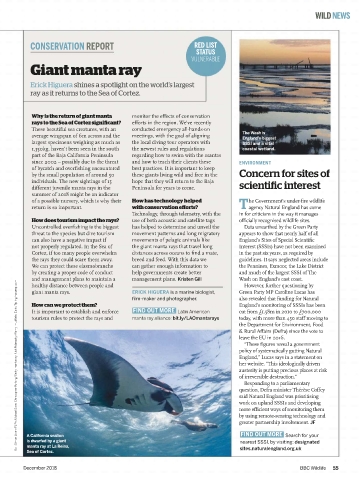
             A California sealion                                                                               FIND OUT MORE Search for your
             is dwarfed by a giant                                                                              nearest SSSI, by visiting: designated
             manta ray at La Reina,                                                                             sites.naturalengland.org.uk
             Sea of Cortez.


            December 2018                                                                                                                  BBC Wildlife    55

