


Page 59 - BBC Wildlife Volume 36 #12
P. 59
WILDNEWS


            ENVIRONMENT
                                                                  TRUTH OR FICTION?
            Scottish kelp

            dredging contested                                   Weshould

                                                                 bescaredof

                lans for licensed dredging of kelp
            Pforests off Scotland’s west coast
            have met widespread opposition from                  harlequin
            environmental and marine protection
            groups. A Scottish Parliamentary                     ladybirds
            committee has now supported a
            ban on taking whole living kelp plants
            from Scottish waters. But Scottish                   They aren’t good for our native
            Government ministers could still seek                two-spots, but do harlequin
            to remove this protection when a bill                ladybirds really pose a threat
            linked to management of coastal waters
            is considered by its parliament in 2019.             to our homes, pets or even
              Small-scale harvesting of kelp has been            ourselves? Helen Roy enlightens.
            carried out in Scotland for centuries,
            but proposals by Ayrshire-based Marine
            Biopolymers Ltd (MBL) are the first for               THE GLORIOUS SUMMERS OF 2018 and                                     But what if you’re
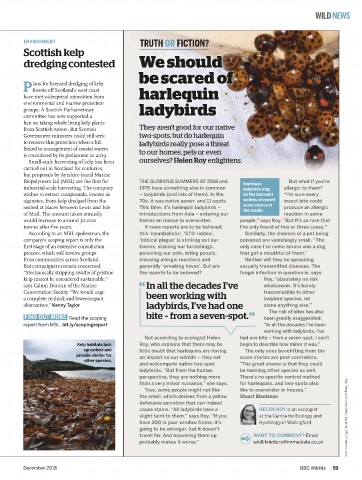
                                                                                                                 Harlequin
            industrial-scale harvesting. The company             1976 have something else in common              ladybirds may      allergic to them?
            wishes to extract compounds, known as                – ladybirds (and lots of them). In the          be the innocent    “I’m sure every
            alginates, from kelp dredged from the                70s, it was native seven- and 11-spots.         victims of recent  insect bite could
                                                                                                                 scare stories in
            seabed at places between Lewis and Isle              This time, it’s harlequin ladybirds –                              produce an allergic
            of Mull. The amount taken annually                   introductions from Asia – entering our          the media.         reaction in some
            would increase to around 30,000                      homes en masse to overwinter.                  people,” says Roy. “But it’s so rare that
            tonnes after five years.                                 If news reports are to be believed,         I’ve only heard of two or three cases.”
              According to an MBL spokesman, the                 this ‘cannibalistic’, ‘STD-ridden’,              Similarly, the chances of a pet being
            company’s scoping report is only the                 ‘biblical plague’ is stinking out our          poisoned are vanishingly small. “The
            first stage of an extensive consultation              homes, staining our furnishings,               only case I’ve come across was a dog
            process, which will involve groups                   poisoning our pets, biting people,             that got a mouthful of them.”
            from communities across Scotland.                    inducing allergic reactions and                  Neither will they be spreading
            But campaigners remain concerned.                    generally ‘wreaking havoc’. But are            sexually transmitted diseases. The
            “Mechanically stripping swaths of pristine           the reports to be believed?                    fungal infection in question is, says
            kelp cannot be considered sustainable,”                                                                        Roy, “absolutely no risk
            says Calum Duncan of the Marine                      S   In all the decades I’ve                               whatsoever. It’s barely
            Conservation Society. “We would urge                                                                           transmissible to other
            a complete re-think and lower-impact                     been working with                                     ladybird species, let
            alternatives.” Kenny Taylor                              ladybirds, I’ve had one                               alone anything else.”
                                                                                                                             The risk of bites has also
                                                                     bite – from a seven-spot.                      T
            FIND OUT MORE Read the scoping                                                                                 been greatly exaggerated.
            report from MBL: bit.ly/scopingreport                                                                          “In all the decades I’ve been
                                                                                                                           working with ladybirds, I’ve
                                                                    Not according to ecologist Helen            had one bite – from a seven-spot. I can’t
                                     Kelp habitats lock          Roy, who explains that there may be            begin to describe how minor it was.”
                                        up carbon and            little doubt that harlequins are having          The only ones benefitting from the
                                    provide shelter for          an impact on our wildlife – they eat           scare stories are pest controllers.
                                        other species.
                                                                 and outcompete native two-spot                 “The great shame is that they could
                                                                 ladybirds. “But from the human                 be harming other species as well.
                                                                 perspective, they are nothing more             There’s no specific control method
                                                                 than a very minor nuisance,” she says.         for harlequins, and two-spots also
                                                                    True, some people might not like            like to overwinter in houses.”
                                                                 the smell, which derives from a yellow         Stuart Blackman
                                                                 defensive secretion that can indeed
                                                                 cause stains. “All ladybirds have a                     HELEN ROY is an ecologist
                                                                 slight taint to them,” says Roy. “If you                at the Centre for Ecology and          Kelp: Feargus Cooney/Getty; ladybirds: ARCO/naturepl.com
                                                                 have 200 in your window frame, it’s                     Hydrology in Wallingford.
                                                                 going to be stronger, but it doesn’t
                                                                 travel far. And hoovering them up                    WANT TO COMMENT? Email
                                                                 probably makes it worse.”                            wildlifeletters@immediate.co.uk


            December 2018                                                                                                                  BBC Wildlife   59

