


Page 203 - The Dinosaur Book and Other Wonders of the Prehistoric World (DK-Smithsonian)
P. 203
Dromaeosaurs                                                                   Mammoth
           A group of birdlike, two-legged,                                               A type of elephant with long   Glossary
           carnivorous dinosaurs.                                                         tusks that lived during the
           Dromaeosaur fossils have been                                                  Pliocene and Pleistocene.
           found on every continent.                                                      During the last ice age,
                                                                                          some mammoths developed
           Embryo                                                                         long hair, which helped
           A plant, animal, or other                                                      them stay warm.
           organism in an early stage
           of development from an                                                         Marsupials
           egg or a seed.                                                                 A group of mammals in
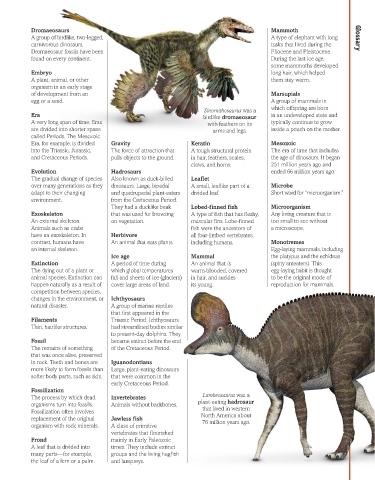
                                                                    Sinornithosaurus was a   which offspring are born
           Era                                                     birdlike dromaeosaur    in an undeveloped state and
           A very long span of time. Eras                            with feathers on its    typically continue to grow
           are divided into shorter spans                              arms and legs.     inside a pouch on the mother.
           called Periods. The Mesozoic
           Era, for example, is divided   Gravity              Keratin                    Mesozoic
           into the Triassic, Jurassic,    The force of attraction that   A tough structural protein    The era of time that includes
           and Cretaceous Periods.   pulls objects to the ground.  in hair, feathers, scales,    the age of dinosaurs. It began
                                                               claws, and horns.          251 million years ago and
           Evolution                 Hadrosaurs                                           ended 66 million years ago.
           The gradual change of species   Also known as duck-billed   Leaflet
           over many generations as they   dinosaurs. Large, bipedal    A small, leaflike part of a   Microbe
           adapt to their changing   and quadrupedal plant-eaters   divided leaf.         Short word for “microorganism.”
           environment.              from the Cretaceous Period.
                                     They had a ducklike beak    Lobed-finned fish        Microorganism
           Exoskeleton               that was used for browsing    A type of fish that has fleshy,   Any living creature that is
           An external skeleton.     on vegetation.            muscular fins. Lobe-finned    too small to see without
           Animals such as crabs                               fish were the ancestors of    a microscope.
           have an exoskeleton. In   Herbivore                 all four-limbed vertebrates,
           contrast, humans have     An animal that eats plants.  including humans.       Monotremes
           an internal skeleton.                                                          Egg-laying mammals, including
                                     Ice age                   Mammal                     the platypus and the echidnas
           Extinction                A period of time during    An animal that is         (spiny anteaters). This
           The dying out of a plant or   which global temperatures    warm-blooded, covered    egg-laying habit is thought
           animal species. Extinction can   fall and sheets of ice (glaciers)   in hair, and suckles    to be the original mode of
           happen naturally as a result of   cover large areas of land.  its young.       reproduction for mammals.
           competition between species,
           changes in the environment, or     Ichthyosaurs
           natural disaster.         A group of marine reptiles
                                     that first appeared in the
           Filaments                 Triassic Period. Ichthyosaurs
           Thin, hairlike structures.  had streamlined bodies similar
                                     to present-day dolphins. They
           Fossil                    became extinct before the end
           The remains of something    of the Cretaceous Period.
           that was once alive, preserved
           in rock. Teeth and bones are   Iguanodontians
           more likely to form fossils than   Large, plant-eating dinosaurs
           softer body parts, such as skin.  that were common in the
                                     early Cretaceous Period.
           Fossilization
           The process by which dead   Invertebrates               Lambeosaurus was a
           organisms turn into fossils.   Animals without backbones.  plant-eating hadrosaur
                                                                   that lived in western
           Fossilization often involves                            North America about
           replacement of the original   Jawless fish              76 million years ago.
           organism with rock minerals.  A class of primitive
                                     vertebrates that flourished
           Frond                     mainly in Early Paleozoic
           A leaf that is divided into    times. They include extinct
           many parts—for example,    groups and the living hagfish
           the leaf of a fern or a palm.  and lampreys.


   US_200-203_Glossary.indd   201                                                                                10/04/18   3:35 PM

