


Page 199 - The Dinosaur Book and Other Wonders of the Prehistoric World (DK-Smithsonian)
P. 199
Early humans                                                                modern humans, the
                                                                                          Very similar to

                                                                                         neanderthals were
                                                                                       sturdy people adapted
                                                                                          for life in the cold
                                                                                          climate of ice-age
                                                                                               Europe.


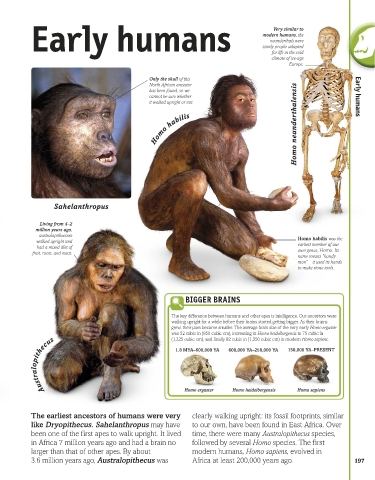
                                                  Only the skull of this
                                                  North African ancestor
                                                  has been found, so we
                                                  cannot be sure whether                                             Early humans
                                                  it walked upright or not.

                                                   Homo habilis                                   Homo neanderthalensis


                   Sahelanthropus


              Living from 4–2
             million years ago,
              australopithecines
             walked upright and                                                                   Homo habilis was the
             had a mixed diet of                                                                  earliest member of our
            fruit, roots, and meat.                                                               own genus, Homo. Its
                                                                                                  name means “handy
                                                                                                  man”—it used its hands
                                                                                                  to make stone tools.


                                                              BIGGER BRAINS


                                                         The key difference between humans and other apes is intelligence. Our ancestors were
                                                         walking upright for a while before their brains started getting bigger. As their brains
                                                         grew, their jaws became smaller. The average brain size of the very early Homo ergaster
                                                         was 52 cubic in (850 cubic cm), increasing in Homo heidelbergensis to 75 cubic in
                Australopithecus                          1.8 MYA–600,000 YA   600,000 YA–250,000 YA   150,000 YA–PRESENT
                                                         (1,225 cubic cm), and finally 82 cubic in (1,350 cubic cm) in modern Homo sapiens.


           The earliest ancestors of humans were very        Homo ergaster   Homo heidelbergensis  Homo sapiens
                                                                clearly walking upright: its fossil footprints, similar
           like Dryopithecus. Sahelanthropus may have           to our own, have been found in East Africa. Over
           been one of the first apes to walk upright. It lived   time, there were many Australopithecus species,
           in Africa 7 million years ago and had a brain no     followed by several Homo species. The first
           larger than that of other apes. By about             modern humans, Homo sapiens, evolved in
           3.6 million years ago, Australopithecus was          Africa at least 200,000 years ago.                   197


   US_196-197_Primates_and_early_humans.indd   197                                                               10/04/18   3:35 PM

