


Page 202 - The Dinosaur Book and Other Wonders of the Prehistoric World (DK-Smithsonian)
P. 202
Glossary  Glossary


           Adaptation                Archaea
           A feature of a living thing    Microscopic organisms                                 This bony fish,
           that helps it thrive in its   that resemble bacteria but                            Cladoselache, had a
           environment and lifestyle.   are only very distantly related.                    skeleton made of cartilage.
           Adaptations are passed on    Some Archaea live in extreme
           to offspring and evolve    environments, such as scalding   Bony fish
           over generations.         or very salty water.      Fish with a skeleton made    the back of the skull. Many,
                                                               of bone. Bony fish are one of   including Triceratops, had
           Allosauroids              Archosaurs                the biggest groups of bony   facial horns.
           A group of theropod dinosaurs   A group of related reptiles    animals, or vertebrates. As
           that lived during the Jurassic   that includes extinct dinosaurs,   well as familiar fish like tuna,   Chitin
           and Cretaceous Periods.   birds, pterosaurs, and    herring, and salmon, the group   An organic substance that
                                     crocodylians. They first   also includes the ancestors    forms the exoskeleton of
           Ammonite                  appeared in the Triassic Period.  of tetrapods.      insects and other arthropods.
           A mollusk, related to squid, that
           had a coiled, chambered shell   Arthropod           Breeding colony            Compound eye
           and lived in Mesozoic seas.  An invertebrate animal with a   A large group of animals    An eye formed from a mosaic
                                     segmented body and a hard   that has gathered to breed    of many smaller eyes. Insects
           Amphibian                 outer covering (exoskeleton).   in one place.        have compound eyes.
           A cold-blooded animal that   Extinct arthropods include
           spends part of its life in water,   trilobites. Living examples   Brood        Creodonts
           such as a frog. They breathe   include insects and spiders.  In birds, to sit on eggs or   An extinct group of
           through their gills in early life,                  nestlings to keep them warm.  flesh-eating mammals.
           but as adults they live on    Bacteria
           land and breathe air through   Microscopic, single-celled   Camouflage         Cyanobacteria
           their lungs.              organisms with no cell    A disguise that helps an animal   Bacteria that can use
                                     nuclei. Bacteria are the most   to blend in with its surroundings.  sunlight to manufacture
           Ancestor                  abundant organisms on Earth.                         their own food
           An animal or plant species                          Carnivore                  by photosynthesis.
           from which a more recent   Bipedal                  An animal that eats meat.
           species has evolved.      Walking on two feet rather                           Cynodonts
                                     than four. Humans and birds   Ceratopsians           A group of synapsids that
           Ankylosaurs               are bipedal, as were many   Plant-eating dinosaurs, with a   arose in the Late Permian
           Four-legged, armored,     dinosaurs.                deep beak and a bony frill at   (see also Synapsids).
           plant-eating dinosaurs with
           bony plates that covered the
           neck, shoulders, and back.

           Antenna
           Movable sense organ on the
           head of animals such as insects.


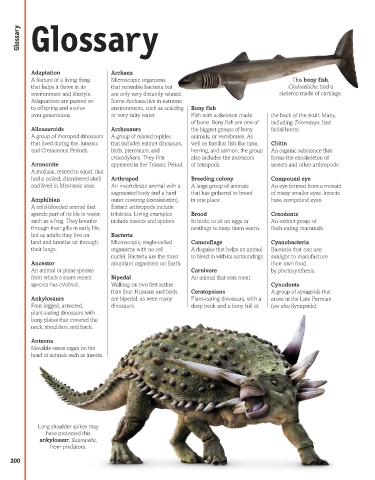
             Long shoulder spikes may
                have protected this
              ankylosaur, Sauropelta,
                 from predators.

    200


   US_200-203_Glossary.indd   200                                                                                10/04/18   3:35 PM

