


Page 140 - Complete Birds of Britain and Europe (DK - RSPB)
P. 140
BIRDS OF PREY
       Order Accipitriformes  Family Accipitridae    Species Accipiter nisus
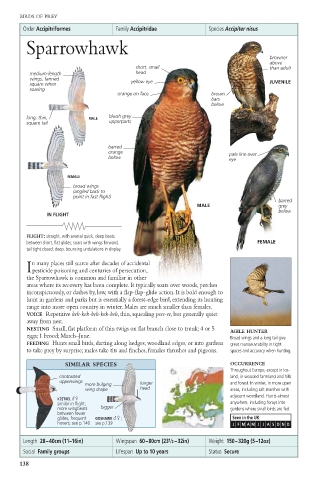
        Sparrowhawk

                                                                    browner
                                                                    above
                                   short, small                     than adult
        medium-length              head
        wings, fanned
        square when               yellow eye                        JUVENILE
        soaring
                              orange on face         brown
                                                     bars
                                                     below
        long, thin,    MALE  bluish grey
        square tail         upperparts
                            barred
                            orange                        pale line over
                            below
                                                          eye
                  FEMALE
                   broad wings
                   (angled back to
                   point in fast flight)
                                                                      barred
                                                  MALE                grey
                                                                      below
             IN FLIGHT
        FLIGHT: straight, with several quick, deep beats
        between short, flat glides; soars with wings forward,    FEMALE
        tail tight closed; deep, bouncing undulations in display.
         n many places still scarce after decades of accidental
        Ipesticide poisoning and centuries of persecution,
        the Sparrowhawk is common and familiar in other
        areas where its recovery has been complete. It typically soars over woods, perches
        inconspicuously, or dashes by, low, with a flap-flap-glide action. It is bold enough to
        hunt in gardens and parks but is essentially a forest-edge bird, extending its hunting
        range into more open country in winter. Males are much smaller than females.
        VOICE Repetitive kek-kek-kek-kek-kek, thin, squealing peee-ee, but generally quiet
        away from nest.
        NESTING Small, flat platform of thin twigs on flat branch close to trunk; 4 or 5  AGILE HUNTER
        eggs; 1 brood; March–June.                        Broad wings and a long tail give
        FEEDING Hunts small birds, darting along hedges, woodland edges, or into gardens  great manoeuvrability in tight
        to take prey by surprise; males take tits and finches, females thrushes and pigeons.  spaces and accuracy when hunting.
                 SIMILAR SPECIES                          OCCURRENCE
                                                          Throughout Europe, except in Ice-
                contrasted                                land, in wooded farmland and hills
                upperwings          longer                and forest. In winter, in more open
                      more bulging
                      wing shape    head                  areas, including salt marshes with
               KESTREL 32                                 adjacent woodland. Hunts almost
               similar in flight;                         anywhere, including forays into
               more wingbeats  bigger                     gardens where small birds are fed.
               between fewer
               glides, frequent  GOSHAWK 32;               Seen in the UK
               hovers; see p.140  see p.139                J  F  M  A  M  JJ A S O  N  D
       Length  28–40cm (11–16in)  Wingspan  60–80cm (23 1 ⁄2 –32in)  Weight  150–320g (5–12oz)
       Social  Family groups  Lifespan  Up to 10 years  Status  Secure
      138

