


Page 143 - Complete Birds of Britain and Europe (DK - RSPB)
P. 143
BIRDS OF PREY
       Order Falconiformes    Family Falconidae      Species Falco naumanni
        Lesser Kestrel                                    pale cheek spot


                                    black-barred
                    blue-grey       back                          blue-grey
                    panel                                         head
                                                       FEMALE
        MALE             dark outer
                         wings
                                    unspotted, rich
                                    red-brown back

                FEMALE
           IN FLIGHT
                                                                      MALE


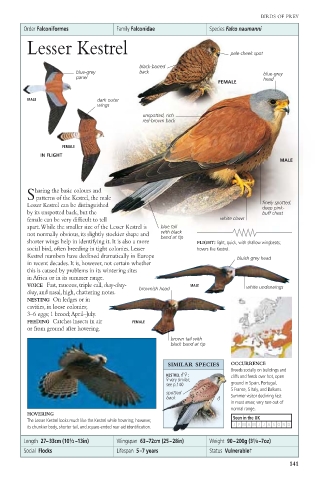
          haring the basic colours and
        S patterns of the Kestrel, the male
        Lesser Kestrel can be distinguished                       finely spotted,
                                                                  deep pink-
        by its unspotted back, but the                            buff chest
        female can be very difficult to tell            white claws
        apart.While the smaller size of the Lesser Kestrel is  blue tail
        not normally obvious, its slightly stockier shape and  with black
                                         band at tip
        shorter wings help in identifying it. It is also a more  FLIGHT: light, quick, with shallow wingbeats;
        social bird, often breeding in tight colonies. Lesser  hovers like Kestrel.
        Kestrel numbers have declined dramatically in Europe  bluish grey head
        in recent decades. It is, however, not certain whether
        this is caused by problems in its wintering sites
        in Africa or in its summer range.
        VOICE Fast, raucous, triple call, chay-chay-  brownish head  MALE  white underwings
        chay, and nasal, high, chattering notes.
        NESTING On ledges or in
        cavities, in loose colonies;
        3–6 eggs; 1 brood;April–July.
        FEEDING Catches insects in air  FEMALE
        or from ground after hovering.
                                           brown tail with
                                           black band at tip

                                           SIMILAR SPECIES  OCCURRENCE
                                                          Breeds socially on buildings and
                                          KESTREL 32;     cliffs and feeds over hot, open
                                          2very similar;
                                          see p.140       ground in Spain, Portugal,
                                                          S France, S Italy, and Balkans.
                                          spotted
                                          back         3  Summer visitor declining fast
                                                          in most areas; very rare out of
                                                          normal range.
        HOVERING
                                                           Seen in the UK
        The Lesser Kestrel looks much like the Kestrel while hovering; however,
                                                           J  F  M  A  M  JJ A S O  N  D
        its chunkier body, shorter tail, and square-ended rear aid identification.
       Length  27–33cm (10 1 ⁄2 –13in)  Wingspan  63–72cm (25–28in)  Weight  90–200g (3 1 ⁄4 –7oz)
       Social  Flocks         Lifespan  5–7 years    Status  Vulnerable†
                                                                         141

