


Page 142 - Complete Birds of Britain and Europe (DK - RSPB)
P. 142
BIRDS OF PREY
       Order Falconiformes    Family Falconidae      Species Falco tinnunculus
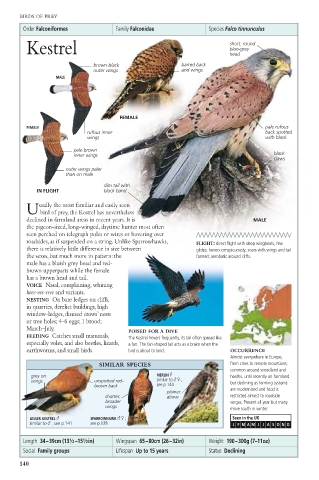
        Kestrel                                           short, round
                                                          blue-grey
                                                          head
                        brown-black           barred back
                        outer wings           and wings
               MALE


                               FEMALE
        FEMALE                                                     pale rufous
                       rufous inner                                back spotted
                       wings                                       with black
                   pale brown
                   inner wings                                       black
                                                                     claws
                 outer wings paler
                 than on male
                           slim tail with
          IN FLIGHT        black band
           sually the most familiar and easily seen
        U bird of prey, the Kestrel has nevertheless
        declined in farmland areas in recent years. It is       MALE
        the pigeon-sized, long-winged, daytime hunter most often
        seen perched on telegraph poles or wires or hovering over
        roadsides, as if suspended on a string. Unlike Sparrowhawks,  FLIGHT: direct flight with deep wingbeats, few
        there is relatively little difference in size between  glides; hovers conspicuously; soars with wings and tail
        the sexes, but much more in pattern: the  fanned; aerobatic around cliffs.
        male has a bluish grey head and red-
        brown upperparts while the female
        has a brown head and tail.
        VOICE Nasal, complaining, whining
        keee-eee-eeee and variants.
        NESTING On bare ledges on cliffs,
        in quarries, derelict buildings, high
        window-ledges, disused crows’ nests
        or tree holes; 4–6 eggs; 1 brood;
        March–July.              POISED FOR A DIVE
        FEEDING Catches small mammals,  The Kestrel hovers frequently, its tail often spread like
        especially voles, and also beetles, lizards,  a fan. The fan-shaped tail acts as a brake when the
        earthworms, and small birds.  bird is about to land.  OCCURRENCE
                                                          Almost everywhere in Europe,
                          SIMILAR SPECIES                 from cities to remote mountains;
                                                          common around woodland and
                                        MERLIN 2
         grey on                                          heaths, until recently on farmland
         wings          unspotted red-  similar to 32;    but declining as farming systems
                        brown back      see p.144
                                          plainer         are modernized and food is
                           shorter,       above           restricted almost to roadside
                           broader                        verges. Present all year but many
                           wings                          move south in winter.
        LESSER KESTREL 3  SPARROWHAWK 32;                  Seen in the UK
        similar to 3; see p.141  see p.138                 J  F  M  A  M  JJ A S O  N  D
       Length  34–39cm (13 1 ⁄2 –15 1 ⁄2in)  Wingspan  65–80cm (26–32in)  Weight  190–300g (7–11oz)
       Social  Family groups  Lifespan  Up to 15 years  Status  Declining
      140

