


Page 145 - Complete Birds of Britain and Europe (DK - RSPB)
P. 145
BIRDS OF PREY
       Order Falconiformes    Family Falconidae      Species Falco peregrinus
        Peregrine                                          yellow eye-ring

                                    yellow bill-base           white cheek patch
               ADULT    anchor-shaped
                        wings
                                        black lobes                  white
                            blue-grey   on each                      breast
        broad               upperparts  side of face
        pale                            and neck
        rump            bluish eye-
                        ring and                                    large, solid
                        bill-base                                   body with
                                                                    broad
        short,  IN FLIGHT                                           shoulders
        square
        dark tail
                                                                   closely
                                                                   barred
                                                                   white
                                                                   underside
                         browner than
                         adult above with
                         buff edges
                       streaked below
                                   ADULT
                          JUVENILE
        buff tail           grey bars on
        tip                 flanks and belly
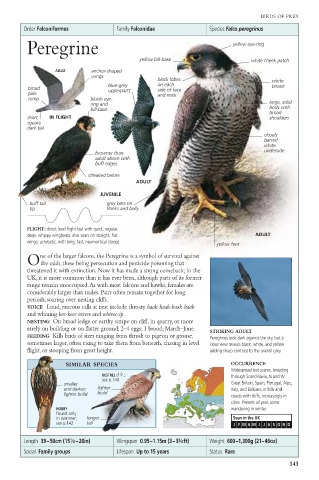
        FLIGHT: direct level flight fast with quick, regular,
        deep, whippy wingbeats; also soars on straight, flat    ADULT
        wings; acrobatic, with long, fast, near-vertical stoops.
                                                       yellow feet
           ne of the larger falcons, the Peregrine is a symbol of survival against
        Othe odds,these being persecution and pesticide poisoning that
        threatened it with extinction. Now it has made a strong comeback; in the
        UK, it is more common than it has ever been, although parts of its former
        range remain unoccupied.As with most falcons and hawks, females are
        considerably larger than males. Pairs often remain together for long
        periods, soaring over nesting cliffs.
        VOICE Loud, raucous calls at nest include throaty haak-haak-haak-haak
        and whining kee-keee-eeeeee and wheeee-ip.
        NESTING On broad ledge or earthy scrape on cliff, in quarry, or more
        rarely on building or on flatter ground; 2–4 eggs; 1 brood; March–June.  STRIKING ADULT
        FEEDING Kills birds of sizes ranging from thrush to pigeon or grouse,  Peregrines look dark against the sky, but a
        sometimes larger, often rising to take them from beneath, chasing in level  close view reveals black, white, and yellow
        flight, or stooping from great height.       adding sharp contrast to the overall grey.
                 SIMILAR SPECIES                          OCCURRENCE
                                                          Widespread but scarce, breeding
                          KESTREL 32;                     through Scandinavia, N and W
                          see p.140
                 smaller                                  Great Britain, Spain, Portugal, Alps,
                 and darker;  lighter                     Italy, and Balkans, in hills and
                 lighter build  build
                                                          coasts with cliffs, increasingly in
                                                          cities. Present all year, some
               HOBBY                                      wandering in winter.
               found only
               in summer;  longer                          Seen in the UK
               see p.142  tail                             J  F  M  A  M  JJ A S O  N  D
       Length  39–50cm (15 1 ⁄2 –20in)  Wingspan  0.95–1.15m (3–3 3 ⁄4ft)  Weight  600–1,300g (21–46oz)
       Social  Family groups  Lifespan  Up to 15 years  Status  Rare
                                                                         143

