


Page 150 - Complete Birds of Britain and Europe (DK - RSPB)
P. 150
GAMEBIRDS
       Order Galliformes      Family Tetraonidae     Species Tetrao urogallus
        Capercaillie                                red wattle       short,
                                                                     hooked
                                                                     thick bill
                                                                     spiky
                    brown                                            beard
                    wings    white-speckled,
                             broad, round
                             black tail
                      MALE
                                                                    huge,
                                                                    blackish
                                                                    grey body
                                                                     bold
                                                                     white
                                                                     shoulder
                  FEMALE  dark bars on                               spot
                       rufous-ginger
       dark bars       body
       on orange
       tail
             IN FLIGHT
                                   broad
                                   orange
                                   chest
                                                         MALE
                                   FEMALE
           white patches on
           flanks and belly
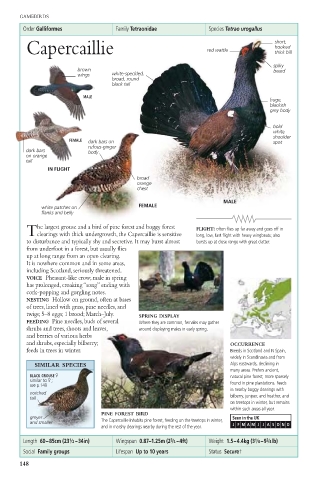
          he largest grouse and a bird of pine forest and boggy forest  FLIGHT: often flies up far away and goes off in
        Tclearings with thick undergrowth, the Capercaillie is sensitive   long, low, fast flight with heavy wingbeats; also
        to disturbance and typically shy and secretive. It may burst almost  bursts up at close range with great clatter.
        from underfoot in a forest, but usually flies
        up at long range from an open clearing.
        It is nowhere common and in some areas,
        including Scotland, seriously threatened.
        VOICE Pheasant-like crow; male in spring
        has prolonged, croaking “song” ending with
        cork-popping and gurgling notes.
        NESTING Hollow on ground, often at bases
        of trees, lined with grass, pine needles, and
        twigs; 5–8 eggs; 1 brood; March–July.  SPRING DISPLAY
        FEEDING Pine needles, buds of several  Where they are common, females may gather
        shrubs and trees, shoots and leaves,  around displaying males in early spring.
        and berries of various herbs
        and shrubs, especially bilberry;                  OCCURRENCE
        feeds in trees in winter.                         Breeds in Scotland and N Spain,
                                                          widely in Scandinavia and from
          SIMILAR SPECIES                                 Alps eastwards, declining in
                                                          many areas. Prefers ancient,
        BLACK GROUSE 2                                    natural pine forest; more sparsely
        similar to 2;                                     found in pine plantations. Feeds
        see p.149
                                                          in nearby boggy clearings with
        notched                                           bilberry, juniper, and heather, and
        tail
                                                          on treetops in winter, but remains
                                                          within such areas all year.
                          PINE FOREST BIRD
        greyer            The Capercaillie inhabits pine forest, feeding on the treetops in winter,  Seen in the UK
        and smaller
                          and in marshy clearings nearby during the rest of the year.  J  F  M  A  M  JJ A S O  N  D
       Length  60–85cm (23 1 ⁄2 –34in)  Wingspan  0.87–1.25m (2 3 ⁄4 –4ft)  Weight  1.5–4.4kg (3 1 ⁄4 –9 3 ⁄4lb)
       Social  Family groups  Lifespan  Up to 10 years  Status  Secure†
      148

