


Page 154 - Complete Birds of Britain and Europe (DK - RSPB)
P. 154
GAMEBIRDS
       Order Galliformes      Family Phasianidae     Species Coturnix coturnix
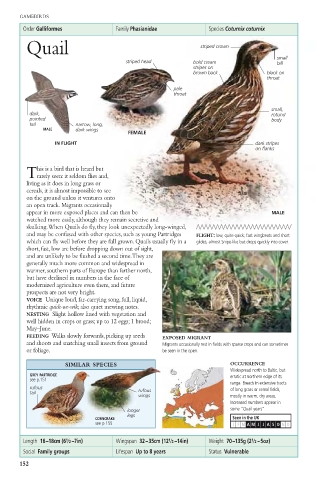
        Quail                                      striped crown

                                                                      small
                                striped head     bold cream           bill
                                                 stripes on
                                                 brown back        black on
                                                                   throat
                                            pale
                                            throat
                                                                    small,
        dark,                                                       rotund
        pointed                                                     body
        tail        narrow, long,
            MALE    dark wings
                                 FEMALE
               IN FLIGHT                                        dark stripes
                                                                on flanks
          his is a bird that is heard but
        Trarely seen: it seldom flies and,
        living as it does in long grass or
        cereals, it is almost impossible to see
        on the ground unless it ventures onto
        an open track. Migrants occasionally
        appear in more exposed places and can then be               MALE
        watched more easily, although they remain secretive and
        skulking.When Quails do fly, they look unexpectedly long-winged,
        and may be confused with other species, such as young Partridges  FLIGHT: low, quite quick; fast wingbeats and short
        which can fly well before they are full grown. Quails usually fly in a  glides, almost Snipe-like but drops quickly into cover.
        short, fast, low arc before dropping down out of sight,
        and are unlikely to be flushed a second time.They are
        generally much more common and widespread in
        warmer, southern parts of Europe than farther north,
        but have declined in numbers in the face of
        modernized agriculture even there, and future
        prospects are not very bright.
        VOICE Unique loud, far-carrying song, full, liquid,
        rhythmic quick-we-wik; also quiet mewing notes.
        NESTING Slight hollow lined with vegetation and
        well hidden in crops or grass; up to 12 eggs; 1 brood;
        May–June.
        FEEDING Walks slowly forwards, picking up seeds   EXPOSED MIGRANT
        and shoots and snatching small insects from ground   Migrants occasionally rest in fields with sparse crops and can sometimes
        or foliage.                      be seen in the open.
                 SIMILAR SPECIES                          OCCURRENCE
                                                          Widespread north to Baltic, but
        GREY PARTRIDGE                                    erratic at northern edge of its
        see p.151
                                                          range. Breeds in extensive tracts
        rufous                                            of long grass or cereal fields,
        tail                       rufous
                                   wings                  mostly in warm, dry areas.
                                                          Increased numbers appear in
                                 longer                   some “Quail years”.
                                 legs
                         CORNCRAKE                         Seen in the UK
                         see p.155                         JF M A  M J  JA S O N D
       Length  16–18cm (6 1 ⁄2 –7in)  Wingspan  32–35cm (12 1 ⁄2 –14in)  Weight  70–135g (2 1 ⁄2 –5oz)
       Social  Family groups  Lifespan  Up to 8 years  Status  Vulnerable
      152

