


Page 151 - Complete Birds of Britain and Europe (DK - RSPB)
P. 151
GAMEBIRDS
       Order Galliformes      Family Tetraonidae     Species Tetrao tetrix
        Black Grouse                                    blue sheen
                                                        on neck
                                    undertail feathers  bold white
                          elongated shape  raised in display  shoulder spot
         broad white
         wingbar
                               curved, broad-
                               tipped outer
                 MALE          feathers
                               on tail
                    fine pale bar
                    on mid-brown                                     glossy
        slightly    wings                                            black
        notched                   white patch                        plumage
        tail                      under tail                      large, heavy,
             FEMALE                                               cockerel-like
            IN FLIGHT                                             body


       dark-barred,
       yellow-brown
       or grey plumage
                              FEMALE                 MALE
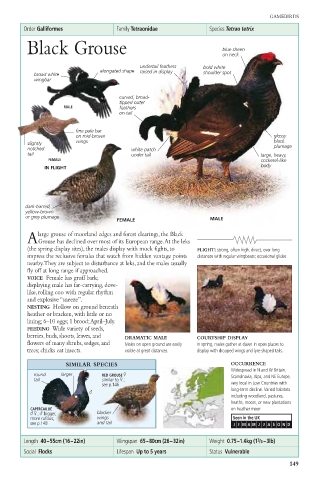
          large grouse of moorland edges and forest clearings, the Black
        AGrouse has declined over most of its European range.At the leks
        (the spring display sites), the males display with mock fights, to  FLIGHT: strong, often high, direct, over long
        impress the reclusive females that watch from hidden vantage points  distances with regular wingbeats; occasional glides.
        nearby.They are subject to disturbance at leks, and the males usually
        fly off at long range if approached.
        VOICE Female has gruff bark;
        displaying male has far-carrying, dove-
        like, rolling coo with regular rhythm
        and explosive “sneeze”.
        NESTING Hollow on ground beneath
        heather or bracken, with little or no
        lining; 6–10 eggs; 1 brood;April–July.
        FEEDING Wide variety of seeds,
        berries, buds, shoots, leaves, and  DRAMATIC MALE  COURTSHIP DISPLAY
        flowers of many shrubs, sedges, and  Males on open ground are easily  In spring, males gather at dawn in open places to
        trees; chicks eat insects.  visible at great distances.  display with drooped wings and lyre-shaped tails.
                 SIMILAR SPECIES                          OCCURRENCE
                                                          Widespread in N and W Britain,
         round  larger    RED GROUSE 2                    Scandinavia, Alps, and NE Europe,
         tail             similar to 2;
                          see p.146                       very local in Low Countries with
                       3                                  long-term decline. Varied habitats
                                                          including woodland, pastures,
                                                          heaths, moors, or new plantations
         CAPERCAILLIE                                     on heather moor.
         32; 3bigger,    blacker
         more rufous;    wings                             Seen in the UK
         see p.148       and tail                          J  F  M  A  M  JJ A S O  N  D
       Length  40–55cm (16–22in)  Wingspan  65–80cm (26–32in)  Weight  0.75–1.4kg (1 3 ⁄4 –3lb)
       Social  Flocks         Lifespan  Up to 5 years  Status  Vulnerable
                                                                         149

