


Page 156 - Complete Birds of Britain and Europe (DK - RSPB)
P. 156
RAILS, CRAKES,AND COOTS/CRANES AND BUSTARDS
        Family Rallidae
        RAILS, CRAKES, AND COOTS

          ATHER SMALL, SLIM BIRDS, rails, crakes, and  or sedges occasionally to give a brief glimpse.
        Rcoots are narrow-bodied, allowing them to  They are, however, skulking rather than shy and
        slip through dense vegetation; however, their  can sometimes be watched very closely.
        deep bellies give a rounder appearance in a side  The Corncrake lives in dry fields of hay and
        view. Most live in wet places. Some are resident,  clumps of irises or nettles,away from open water;
        others long-distance migrants.   it is hard to see but easy to hear its loud,repetitive
         The Moorhen is common and familiar, and  “song”. In most European countries it has
        easy to see; the Coot is more gregarious and also declined severely
        easy to watch in large numbers on almost any  with modernization
        freshwater pool. Others, however, such as the  of farming techniques.
        smaller crakes and the Water Rail, live in such
        dense vegetation that they are difficult to see
        at all, or come only to the edge of the reeds

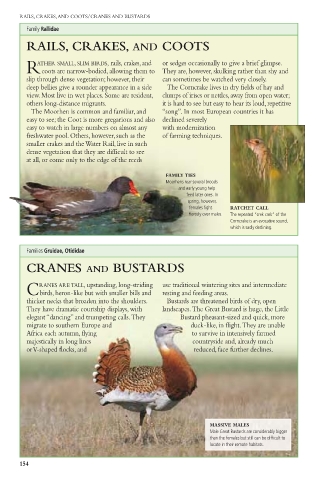
                                          FAMILY TIES
                                          Moorhens rear several broods
                                             and early young help
                                               feed later ones. In
                                                spring, however,
                                                females fight  RATCHET CALL
                                                fiercely over males.  The repeated “crek crek” of the
                                                          Corncrake is an evocative sound,
                                                          which is sadly declining.

        Families Gruidae, Otididae

        CRANES AND BUSTARDS

           RANES ARE TALL, upstanding, long-striding  use traditional wintering sites and intermediate
        Cbirds, heron-like but with smaller bills and  resting and feeding areas.
        thicker necks that broaden into the shoulders.  Bustards are threatened birds of dry, open
        They have dramatic courtship displays, with  landscapes.The Great Bustard is huge, the Little
        elegant “dancing” and trumpeting calls.They  Bustard pheasant-sized and quick, more
        migrate to southern Europe and          duck-like, in flight.They are unable
        Africa each autumn, flying               to survive in intensively farmed
        majestically in long lines               countryside and, already much
        or V-shaped flocks, and                  reduced, face further declines.


                                                     MASSIVE MALES
                                                     Male Great Bustards are considerably bigger
                                                     than the females but still can be difficult to
                                                     locate in their remote habitats.

      154

