


Page 217 - Complete Birds of Britain and Europe (DK - RSPB)
P. 217
SKUAS, GULLS,AND TERNS
       Order Charadriiformes  Family Laridae         Species Larus glaucoides
        Iceland Gull                                 clouded buff-  short, pale
                                                     brown and
                                                                yellow bill
                                                     grey from head
                                                     to breast  with red spot
              wingtips               round head
              fade to  barring on oatmeal-
              buff-ivory  brown body     blackish bill with
                                         dull pale base
                long wings
                                             pale grey
                                             back


                             IMMATURE
                             (1ST WINTER)
                                                                ADULT
         IMMATURE                wingtips     short legs        (WINTER)
         (1ST WINTER)
                                 extend well
                                 beyond tail
                        ADULT
                        (WINTER)
          IN FLIGHT
                        white wingtips
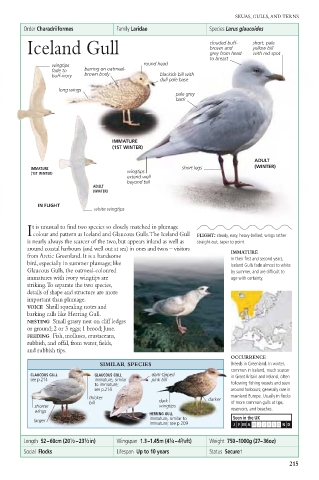
         t is unusual to find two species so closely matched in plumage
        Icolour and pattern as Iceland and Glaucous Gulls.The Iceland Gull  FLIGHT: steady, easy, heavy-bellied; wings rather
        is nearly always the scarcer of the two, but appears inland as well as  straight-out, taper to point.
        around coastal harbours (and well out at sea) in ones and twos – visitors  IMMATURE
        from Arctic Greenland. It is a handsome           In their first and second years,
        bird, especially in summer plumage; like          Iceland Gulls fade almost to white
        Glaucous Gulls, the oatmeal-coloured              by summer, and are difficult to
        immatures with ivory wingtips are                 age with certainty.
        striking.To separate the two species,
        details of shape and structure are more
        important than plumage.
        VOICE Shrill squealing notes and
        barking calls like Herring Gull.
        NESTING Small grassy nest on cliff ledges
        or ground; 2 or 3 eggs; 1 brood; June.
        FEEDING Fish, molluscs, crustaceans,
        rubbish, and offal, from water, fields,
        and rubbish tips.
                                                          OCCURRENCE
                          SIMILAR SPECIES                 Breeds in Greenland. In winter,
                                                          common in Iceland, much scarcer
         GLAUCOUS GULL   GLAUCOUS GULL  dark-tipped       in Great Britain and Ireland, often
         see p.214       immature, similar  pink bill
                         to immature;                     following fishing vessels and seen
                         see p.214                        around harbours; generally rare in
                                                          mainland Europe. Usually in flocks
                       thicker           dark        darker
                       bill                               of more common gulls at tips,
          shorter                        wingtips         reservoirs, and beaches.
          wings
                                      HERRING GULL
                                      immature, similar to  Seen in the UK
         larger
                                      immature; see p.209  J  F  M  A  M  JJ A S O  N  D
       Length  52–60cm (20 1 ⁄2 –23 1 ⁄2in)  Wingspan  1.3–1.45m (4 1 ⁄4 –4 3 ⁄4ft)  Weight  750–1000g (27–36oz)
       Social  Flocks         Lifespan  Up to 10 years  Status  Secure†
                                                                         215

