


Page 219 - Complete Birds of Britain and Europe (DK - RSPB)
P. 219
SKUAS, GULLS,AND TERNS
       Order Charadriiformes  Family Sternidae       Species Sterna albifrons
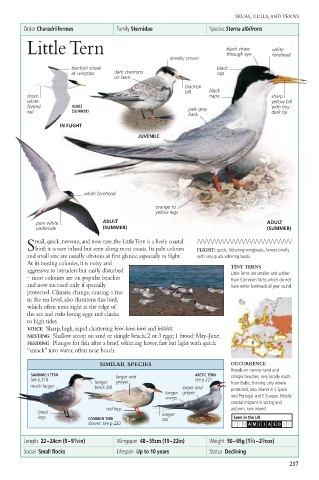
        Little Tern                                      black stripe  white

                                           streaky crown  through eye  forehead
                   blackish streak                     black
                   at wingtips  dark chevrons          cap
                             on back
                                               blackish
                                               bill  black
        short,                                       nape           sharp
        white                                                       yellow bill
        forked     ADULT                        pale grey           with tiny
        tail       (SUMMER)                                         dark tip
                                                back
                IN FLIGHT
                                   JUVENILE


                      white forehead
                                        orange to
                                        yellow legs
          pure white       ADULT                                   ADULT
          underside        (SUMMER)                                (SUMMER)
          mall,quick,nervous,and now rare,the Little Tern is a lively coastal
        Sbird; it is rare inland but seen along most coasts. Its pale colours  FLIGHT: quick, flickering wingbeats; hovers briefly
        and small size are usually obvious at first glance,especially in flight.  with very quick whirring beats.
        At its nesting colonies,it is noisy and           TINY TERNS
        aggressive to intruders but easily disturbed      Little Terns are smaller and whiter
        – most colonies are on popular beaches            than Common Terns which do not
        and now succeed only if specially                 have white foreheads all year round.
        protected. Climate change, causing a rise
        in the sea level, also threatens this bird,
        which often nests right at the edge of
        the sea and risks losing eggs and chicks
        to high tides.
        VOICE Sharp, high, rapid chattering kirri-kirri-kirri and kitititit.
        NESTING Shallow scoop on sand or shingle beach;2 or 3 eggs;1 brood;May–June.
        FEEDING Plunges for fish after a brief, whirring hover, fast but light with quick
        “smack” into water, often near beach.
                          SIMILAR SPECIES                 OCCURRENCE
                                                          Breeds on narrow sand and
         SANDWICH TERN        larger and         ARCTIC TERN  shingle beaches, very locally south
         see p.218                               see p.221
                         longer  greyer                   from Baltic, thriving only where
         much larger     black bill           larger and  protected; also inland in S Spain
                                          longer  greyer
                                          wings           and Portugal and E Europe. Mostly
                                                          coastal migrant in spring and
                           red legs                       autumn, rare inland.
          black                          longer
          legs         COMMON TERN       tail              Seen in the UK
                       slower; see p.220                   J  F  M  A  M  JJ A S O  N  D
       Length  22–24cm (9–9 1 ⁄2in)  Wingspan  48–55cm (19–22in)  Weight  50–65g (1 3 ⁄4 –2 3 ⁄8oz)
       Social  Small flocks   Lifespan  Up to 10 years  Status  Declining
                                                                         217

