


Page 231 - Complete Birds of Britain and Europe (DK - RSPB)
P. 231
SKUAS, GULLS,AND TERNS
       Order Charadriiformes  Family Alcidae         Species Uria aalge
        Guillemot                                sharp, dagger-  dark brown to
                                                 like bill
                                                          black above
                                           long
                                           neck
                      white underparts,
        short,        rounded against         swims low
        square        black throat
        tail
                                                          ADULT (SUMMER)
                                                       black line through  dark cap
                                             upright   eye on white face
                                             posture   ( juvenile similar)
                   ADULT
        dark
        rump with  (SUMMER)
        narrow
        white sides
        white trailing
        edge
                                        ADULT
               IN FLIGHT
                                        (SUMMER)
                                                         ADULT (WINTER)
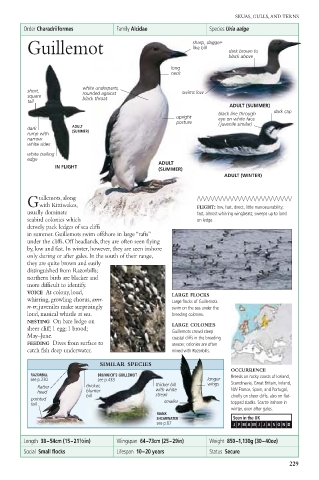
           uillemots, along
        Gwith Kittiwakes,                         FLIGHT: low, fast, direct, little manoeuvrability;
        usually dominate                          fast, almost whirring wingbeats; sweeps up to land
        seabird colonies which                    on ledge.
        densely pack ledges of sea cliffs
        in summer. Guillemots swim offshore in large “rafts”
        under the cliffs. Off headlands, they are often seen flying
        by, low and fast. In winter, however, they are seen inshore
        only during or after gales. In the south of their range,
        they are quite brown and easily
        distinguished from Razorbills;
        northern birds are blacker and
        more difficult to identify.
        VOICE At colony, loud,              LARGE FLOCKS
        whirring, growling chorus, arrrr-   Large flocks of Guillemots
        rr-rr; juveniles make surprisingly  swim on the sea under the
        loud, musical whistle at sea.       breeding colonies.
        NESTING On bare ledge on            LARGE COLONIES
        sheer cliff; 1 egg; 1 brood;        Guillemots crowd steep
        May–June.                           coastal cliffs in the breeding
        FEEDING Dives from surface to       season; colonies are often
        catch fish deep underwater.         mixed with Razorbills.
                          SIMILAR SPECIES
                                                          OCCURRENCE
         RAZORBILL       BRUNNICH’S GUILLEMOT             Breeds on rocky coasts of Iceland,
         see p.230       see p.433                   longer  Scandinavia, Great Britain, Ireland,
          flatter     thicker,          thicker bill  wings  NW France, Spain, and Portugal,
          head        blunter           with white
                      bill              streak            chiefly on sheer cliffs, also on flat-
         pointed                          smaller
         tail                                             topped stacks. Scarce inshore in
                                                          winter, even after gales.
                                        MANX
                                        SHEARWATER         Seen in the UK
                                        see p.67           J  F  M  A  M  JJ A S O  N  D
      . Length  38–54cm (15–21 1 ⁄2in)  Wingspan  64–73cm (25–29in)  Weight  850–1,130g (30–40oz)
       Social  Small flocks   Lifespan  10–20 years  Status  Secure
                                                                         229

