


Page 232 - Complete Birds of Britain and Europe (DK - RSPB)
P. 232
SKUAS, GULLS,AND TERNS
       Order Charadriiformes  Family Alcidae         Species Alca torda
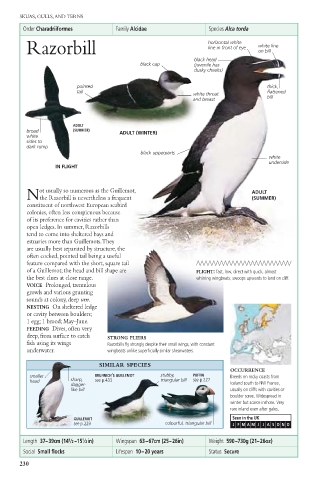
        Razorbill                                    horizontal white  white line
                                                     line in front of eye
                                                                 on bill
                                                 black head
                                    black cap    (juvenile has
                                                 dusky cheeks)
                    pointed                                        thick,
                    tail                                           flattened
                                                 white throat
                                                 and breast        bill

                   ADULT
        broad      (SUMMER)    ADULT (WINTER)
        white
        sides to
        dark rump
                                    black upperparts
                                                                    white
                                                                    underside
               IN FLIGHT
           ot usually so numerous as the Guillemot,             ADULT
        Nthe Razorbill is nevertheless a frequent               (SUMMER)
        constituent of northwest European seabird
        colonies, often less conspicuous because
        of its preference for cavities rather than
        open ledges. In summer, Razorbills
        tend to come into sheltered bays and
        estuaries more than Guillemots.They
        are usually best separated by structure, the
        often cocked, pointed tail being a useful
        feature compared with the short, square tail
        of a Guillemot; the head and bill shape are  FLIGHT: fast, low, direct with quick, almost
        the best clues at close range.            whirring wingbeats; swoops upwards to land on cliff.
        VOICE Prolonged, tremulous
        growls and various grunting
        sounds at colony, deep urrr.
        NESTING On sheltered ledge
        or cavity between boulders;
        1 egg; 1 brood; May–June.
        FEEDING Dives, often very
        deep, from surface to catch  STRONG FLIERS
        fish using its wings  Razorbills fly strongly despite their small wings, with constant
        underwater.         wingbeats unlike superficially similar shearwaters.
                          SIMILAR SPECIES
                                                          OCCURRENCE
        smaller          BRUNNICH’S GUILLEMOT  stubby,  PUFFIN  Breeds on rocky coasts from
        head       sharp,  see p.433     triangular bill  see p.227  Iceland south to NW France,
                   dagger-
                   like bill                              usually on cliffs with cavities or
                                                          boulder scree. Widespread in
                                                          winter but scarce inshore. Very
                                                          rare inland even after gales.
                   GUILLEMOT                               Seen in the UK
                   see p.229              colourful, triangular bill  J  F  M  A  M  JJ A S O  N  D
       Length  37–39cm (14 1 ⁄2 –15 1 ⁄2in)  Wingspan  63–67cm (25–26in)  Weight  590–730g (21–26oz)
       Social  Small flocks   Lifespan  10–20 years  Status  Secure
      230

