


Page 236 - Complete Birds of Britain and Europe (DK - RSPB)
P. 236
PIGEONS AND DOVES
       Order Columbiformes    Family Columbidae      Species Columba palumbus
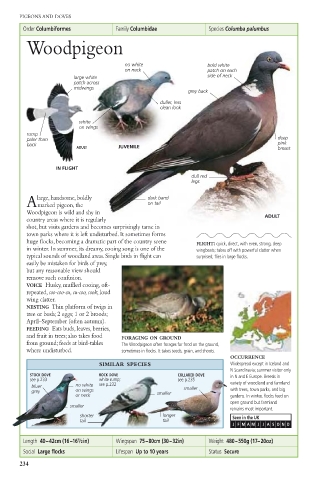
        Woodpigeon


                                no white             bold white
                                on neck              patch on each
                   large white                       side of neck
                   patch across
                   midwings
                                                grey back
                                         duller, less
                                         clean look
                     white
                     on wings
        rump
        paler than                                                    deep
        back                  JUVENILE                                pink
                    ADULT                                             breast
               IN FLIGHT
                                                 dull red
                                                 legs
          large, handsome, boldly     dark band
        Amarked pigeon, the           on tail
        Woodpigeon is wild and shy in                              ADULT
        country areas where it is regularly
        shot, but visits gardens and becomes surprisingly tame in
        town parks where it is left undisturbed. It sometimes forms
        huge flocks, becoming a dramatic part of the country scene   FLIGHT: quick, direct, with even, strong, deep
        in winter. In summer, its dreamy, cooing song is one of the  wingbeats; takes off with powerful clatter when
        typical sounds of woodland areas.Single birds in flight can  surprised; flies in large flocks.
        easily be mistaken for birds of prey,
        but any reasonable view should
        remove such confusion.
        VOICE Husky, muffled cooing, oft-
        repeated, coo-coo-cu, cu-coo, cook; loud
        wing clatter.
        NESTING Thin platform of twigs in
        tree or bush; 2 eggs; 1 or 2 broods;
        April–September (often autumn).
        FEEDING Eats buds, leaves, berries,
        and fruit in trees; also takes food  FORAGING ON GROUND
        from ground; feeds at bird-tables  The Woodpigeon often forages for food on the ground,
        where undisturbed.     sometimes in flocks. It takes seeds, grain, and shoots.
                                                          OCCURRENCE
                          SIMILAR SPECIES                 Widespread except in Iceland and
                                                          N Scandinavia; summer visitor only
        STOCK DOVE        ROCK DOVE          COLLARED DOVE  in N and E Europe. Breeds in
        see p.233         white rump;        see p.235    variety of woodland and farmland
         bluer      no white  see p.232        smaller
         grey       on wings            smaller           with trees, town parks, and big
                    or neck                               gardens. In winter, flocks feed on
                                                          open ground but farmland
                  smaller
                                                          remains most important.
                     shorter             longer            Seen in the UK
                     tail                tail
                                                           J  F  M  A  M  JJ A S O  N  D
       Length  40–42cm (16–16 1 ⁄2in)  Wingspan  75–80cm (30–32in)  Weight  480–550g (17–20oz)
       Social  Large flocks   Lifespan  Up to 10 years  Status  Secure
      234

