


Page 233 - Complete Birds of Britain and Europe (DK - RSPB)
P. 233
PIGEONS AND DOVES/CUCKOOS
        Family Columbidae
        PIGEONS AND DOVES

           HIS IS A RATHER ARTIFICIAL distinction   Nests are flimsy affairs and eggs are always pure,
        Tin a large family found worldwide. In  unmarked white. Shells may be found on the
        Europe, some species commonly called “doves”  ground where they are dropped, far from the
        (Stock Dove and Rock Dove) are more like the  nest, by the parent birds after hatching. Breeding
        “pigeons”, being rather larger and heavier, and  seasons are long and nesting is timed to coincide
        shorter-tailed, than the more delicate species  with a local abundance of food.
        that are usually called doves.
         They are all round-bodied, soft-plumaged
        birds whose plumage seems to come away easily
        in an “explosion” of feathers in any collision,
        perhaps helping them to escape predators.
        They have short, usually red, legs and small
        bills with the nostrils in a fleshy bump at
        the base (the “cere”). Bill and leg colours
        can be bright and obvious but are of
        limited value in identification, which
        more often rests on differences in wing
        and tail patterns.There is little variation
        in appearance between sexes and seasons,
        and juveniles look much like their parents,
        generally being a little duller or marked
        with paler feather edges.
         Pigeons and doves drink by sucking water
        up in a continuous draught, unlike other birds
        that have to raise their heads to tip water back
        into their throats.They have loud, simple
        vocalizations with little obvious differentiation
        between calls and songs, which are good
        identification clues, but, with the exception of
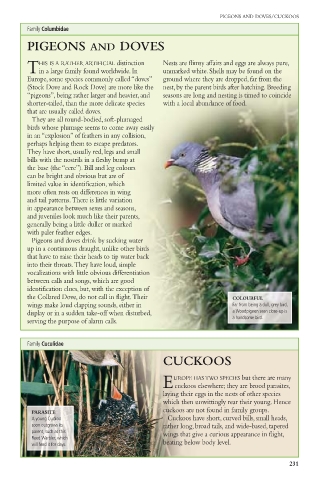
        the Collared Dove, do not call in flight.Their     COLOURFUL
        wings make loud clapping sounds, either in         Far from being a dull, grey bird,
        display or in a sudden take-off when disturbed,    a Woodpigeon seen close-up is
                                                           a handsome bird.
        serving the purpose of alarm calls.

        Family Cuculidae
                                          CUCKOOS

                                            UROPE HAS TWO SPECIES but there are many
                                          E cuckoos elsewhere; they are brood parasites,
                                          laying their eggs in the nests of other species
                                          which then unwittingly rear their young. Hence
         PARASITE                         cuckoos are not found in family groups.
         A young Cuckoo                    Cuckoos have short, curved bills, small heads,
         soon outgrows its                rather long, broad tails, and wide-based, tapered
         parent, such as this             wings that give a curious appearance in flight,
         Reed Warbler, which
         will feed it for days.           beating below body level.

                                                                         231

