


Page 275 - Complete Birds of Britain and Europe (DK - RSPB)
P. 275
MARTINS AND SWALLOWS
       Order Passeriformes    Family Hirundinidae    Species Riparia riparia
        Sand Martin


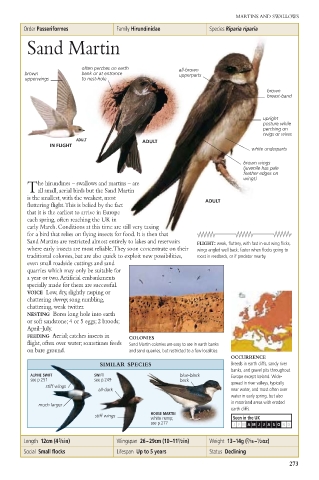
                     often perches on earth  all-brown
       brown         bank or at entrance     upperparts
       upperwings    to nest-hole
                                                                   brown
                                                                   breast-band

                                                                  upright
                                                                  posture while
                                                                  perching on
                                                                  twigs or wires
                    ADULT           ADULT
             IN FLIGHT
                                                               white underparts
                                                             brown wings
                                                             (juvenile has pale
                                                             feather edges on
                                                             wings)
          he hirundines – swallows and martins – are
        Tall small, aerial birds but the Sand Martin
        is the smallest, with the weakest, most     ADULT
        fluttering flight.This is belied by the fact
        that it is the earliest to arrive in Europe
        each spring, often reaching the UK in
        early March. Conditions at this time are still very taxing
        for a bird that relies on flying insects for food. It is then that
        Sand Martins are restricted almost entirely to lakes and reservoirs  FLIGHT: weak, fluttery, with fast in-out wing flicks,
        where early insects are most reliable.They soon concentrate on their  wings angled well back; faster when flocks going to
        traditional colonies, but are also quick to exploit new possibilities,  roost in reedbeds, or if predator nearby.
        even small roadside cuttings and sand
        quarries which may only be suitable for
        a year or two.Artificial embankments
        specially made for them are successful.
        VOICE Low, dry, slightly rasping or
        chattering chrrrrp; song rambling,
        chattering, weak twitter.
        NESTING Bores long hole into earth
        or soft sandstone; 4 or 5 eggs; 2 broods;
        April–July.
        FEEDING Aerial; catches insects in  COLONIES
        flight, often over water; sometimes feeds  Sand Martin colonies are easy to see in earth banks
        on bare ground.          and sand quarries, but restricted to a few localities.
                                                          OCCURRENCE
                          SIMILAR SPECIES                 Breeds in earth cliffs, sandy river
                                                          banks, and gravel pits throughout
         ALPINE SWIFT   SWIFT                 blue-black  Europe except Iceland. Wide-
         see p.251      see p.249             back        spread in river valleys, typically
            stiff wings
                         all-dark                         near water, and most often over
                                                          water in early spring, but also
                                                          in moorland areas with eroded
           much larger
                                                          earth cliffs.
                                      HOUSE MARTIN
                         stiff wings
                                      white rump;          Seen in the UK
                                      see p.277            J  F  M  A  M  JJ A S O  N  D
       Length  12cm (4 3 ⁄4in)  Wingspan  26–29cm (10–11 1 ⁄2in)  Weight  13–14g ( 7 ⁄16 – 1 ⁄2oz)
       Social  Small flocks   Lifespan  Up to 5 years  Status  Declining
                                                                         273

