


Page 273 - Complete Birds of Britain and Europe (DK - RSPB)
P. 273
LARKS
       Order Passeriformes    Family Alaudidae       Species Eremophila alpestris
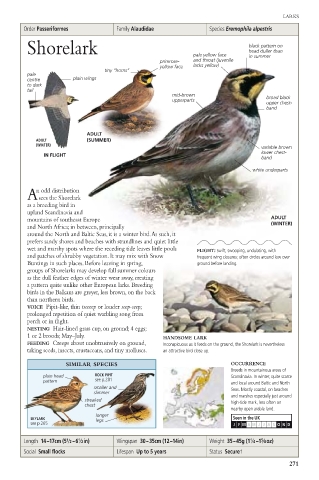
        Shorelark                                              black pattern on
                                                 pale yellow face  head duller than
                                                               in summer
                                         primrose-  and throat (juvenile
                                         yellow face  lacks yellow)
                           tiny “horns”
        pale
        centre     plain wings
        to dark
        tail
                                            mid-brown              broad black
                                            upperparts
                                                                   upper chest-
                                                                   band
                       ADULT
          ADULT        (SUMMER)
          (WINTER)
                                                                  variable brown
                                                                  lower chest-
            IN FLIGHT
                                                                  band
                                                                white underparts
          n odd distribution
        Asees the Shorelark
        as a breeding bird in
        upland Scandinavia and
        mountains of southeast Europe                               ADULT
        and North Africa; in between, principally                   (WINTER)
        around the North and Baltic Seas, it is a winter bird.As such, it
        prefers sandy shores and beaches with strandlines and quiet little
        wet and marshy spots where the receding tide leaves little pools  FLIGHT: swift, swooping, undulating, with
        and patches of shrubby vegetation. It may mix with Snow  frequent wing closures; often circles around low over
        Buntings in such places. Before leaving in spring,  ground before landing.
        groups of Shorelarks may develop full summer colours
        as the dull feather edges of winter wear away, creating
        a pattern quite unlike other European larks. Breeding
        birds in the Balkans are greyer, less brown, on the back
        than northern birds.
        VOICE Pipit-like, thin tseeeep or louder seep-seep;
        prolonged repetition of quiet warbling song from
        perch or in flight.
        NESTING Hair-lined grass cup, on ground; 4 eggs;
        1 or 2 broods; May–July.          HANDSOME LARK
        FEEDING Creeps about unobtrusively on ground,  Inconspicuous as it feeds on the ground, the Shorelark is nevertheless
        taking seeds, insects, crustaceans, and tiny molluscs.  an attractive bird close up.
                 SIMILAR SPECIES                          OCCURRENCE
                                                          Breeds in mountainous areas of
            plain head   ROCK PIPIT                       Scandinavia. In winter, quite scarce
            pattern      see p.281
                                                          and local around Baltic and North
                        smaller and                       Seas. Mostly coastal, on beaches
                        slimmer
                                                          and marshes especially just around
                      streaked                            high-tide mark, less often on
                      chest
                                                          nearby open arable land.
                         longer
         SKYLARK         legs                              Seen in the UK
         see p.265                                         JF M A  M J  JA S ON D
       Length  14–17cm (5 1 ⁄2 –6 1 ⁄2in)  Wingspan  30–35cm (12–14in)  Weight  35–45g (1 1 ⁄4 –1 5 ⁄8oz)
       Social  Small flocks   Lifespan  Up to 5 years  Status  Secure†
                                                                         271

