


Page 274 - Complete Birds of Britain and Europe (DK - RSPB)
P. 274
MARTINS AND SWALLOWS
        Family Hirundinidae
        MARTINS AND SWALLOWS

           OLLECTIVELY KNOWN AS “hirundines”,
        Cthese are highly aerial birds, feeding almost
        entirely by catching flying insects while on the
        wing.They have tiny bills but wide mouths.
        Their feet are very small, but strong enough to
        give a good grasp on a wire or twig: they perch
        frequently, unlike swifts.
        MARTINS
        Martins are stockier than most swallows and
        lack the very long outer tail feathers that are so
                                         SUN-BATHING
        prominent on their close relatives.They have  House Martins take advantage of a rooftop in warm autumn sunlight.
        rather broad-based wings that taper to a point  Their white rumps are fluffed out and obvious.
        and deeply forked tails on a barrel-shaped body.
        House Martins make obvious mud-pellet nests  larger prey, with a more fluent, swooping flight.
        on buildings while Sand Martins tunnel into  All have elongated outer tail feathers, which are
        sand cliffs in sizeable colonies.  longest on the oldest and fittest males. Red-
                                         rumped Swallows make mud-pellet nests like
        SWALLOWS                         House Martins, but with an entrance “porch”,
        The most elegant of the group, the swallows tend while Swallows nest inside small buildings in
        to feed lower down than the martins, and on  a more concealed position.
                                          In late summer and autumn, flocks of swallows
                                         and martins gather together, often using reed-
                                         beds as roosts, before migrating to Africa. House
                                         Martins seem to remain at great heights while
                                         in Africa and are little observed. Swallows from
                                         Europe occupy different parts of southern Africa
                                         during their stay there.


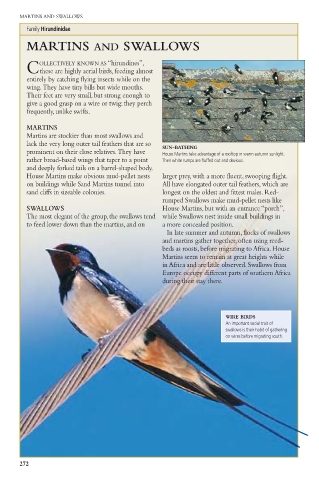
                                                         WIRE BIRDS
                                                         An important social trait of
                                                         swallows is their habit of gathering
                                                         on wires before migrating south.


      272

