


Page 271 - Complete Birds of Britain and Europe (DK - RSPB)
P. 271
LARKS
       Order Passeriformes    Family Alaudidae       Species Calandrella brachydactyla
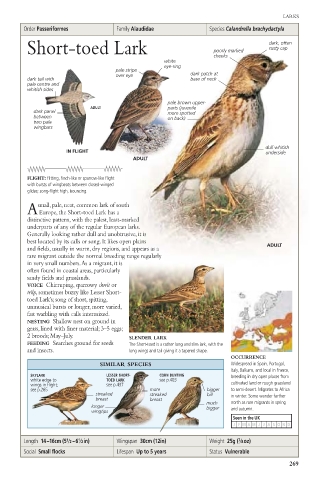
        Short-toed Lark                               poorly marked  dark, often
                                                                    rusty cap
                                                      cheeks
                                          white
                                          eye-ring
                              pale stripe
                              over eye          dark patch at
        dark tail with                          base of neck
        pale centre and
        whitish sides
                                           pale brown upper-
                       ADULT               parts (juvenile
         dark panel                        more spotted
         between                           on back)
         two pale
         wingbars
                                                                   dull whitish
                 IN FLIGHT                                         underside
                                  ADULT

        FLIGHT: flitting, finch-like or sparrow-like flight
        with bursts of wingbeats between closed-winged
        glides; song-flight high, bouncing.
          small, pale, neat, common lark of south
        A Europe, the Short-toed Lark has a
        distinctive pattern, with the palest, least-marked
        underparts of any of the regular European larks.
        Generally looking rather dull and unobtrusive, it is
        best located by its calls or song. It likes open plains    ADULT
        and fields, usually in warm, dry regions, and appears as a
        rare migrant outside the normal breeding range regularly
        in very small numbers.As a migrant, it is
        often found in coastal areas, particularly
        sandy fields and grasslands.
        VOICE Chirruping, sparrowy chrrit or
        trilp, sometimes buzzy like Lesser Short-
        toed Lark’s; song of short, spitting,
        unmusical bursts or longer, more varied,
        fast warbling with calls intermixed.
        NESTING Shallow nest on ground in
        grass, lined with finer material; 3–5 eggs;
        2 broods; May–July.      SLENDER LARK
        FEEDING Searches ground for seeds  The Short-toed is a rather long and slim lark, with the
        and insects.             long wings and tail giving it a tapered shape.
                                                          OCCURRENCE
                          SIMILAR SPECIES                 Widespread in Spain, Portugal,
                                                          Italy, Balkans, and local in France,
         SKYLARK           LESSER SHORT-  CORN BUNTING    breeding in dry open places from
         white edge to     TOED LARK     see p.403
         wings in flight;  see p.437                      cultivated land or rough grassland
         see p.265                    more          bigger  to semi-desert. Migrates to Africa
                         streaked     streaked      bill  in winter. Some wander farther
                         breast       breast
                                                    much  north as rare migrants in spring
                        longer                      bigger  and autumn.
                        wingtips
                                                           Seen in the UK
                                                           JF M A  M J  JA S ON D
       Length  14–16cm (5 1 ⁄2 –6 1 ⁄2in)  Wingspan  30cm (12in)  Weight  25g ( 7 ⁄8oz)
       Social  Small flocks   Lifespan  Up to 5 years  Status  Vulnerable
                                                                         269

