


Page 276 - Complete Birds of Britain and Europe (DK - RSPB)
P. 276
MARTINS AND SWALLOWS
       Order Passeriformes    Family Hirundinidae    Species Ptynoprogne rupestris
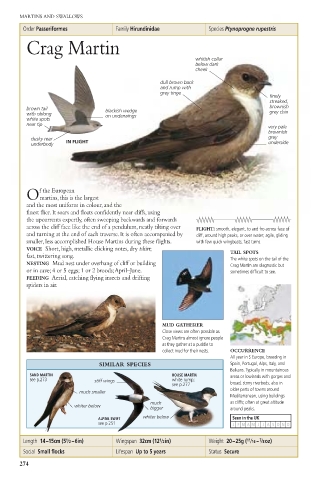
        Crag Martin

                                                  whitish collar
                                                  below dark
                                                  cheek
                                         dull brown back
                                         and rump with
                                         grey tinge
                                                                    finely
                                                                    streaked,
        brown tail         blackish wedge                           brownish
        with oblong        on underwings                            grey chin
        white spots
        near tip
                                                                    very pale
                                                                    brownish
         dusky rear  IN FLIGHT                                      grey
         underbody                                                  underside


           f the European
        Omartins, this is the largest
        and the most uniform in colour, and the
        finest flier. It soars and floats confidently near cliffs, using
        the upcurrents expertly, often sweeping backwards and forwards
        across the cliff face like the end of a pendulum, neatly tilting over  FLIGHT: smooth, elegant, to and fro across face of
        and turning at the end of each traverse. It is often accompanied by  cliff, around high peaks, or over water; agile, gliding
        smaller, less accomplished House Martins during these flights.  with few quick wingbeats, fast turns.
        VOICE Short, high, metallic clicking notes, dry tshirr;  TAIL SPOTS
        fast, twittering song.                            The white spots on the tail of the
        NESTING Mud nest under overhang of cliff or building  Crag Martin are diagnostic but
        or in cave; 4 or 5 eggs; 1 or 2 broods;April–June.  sometimes difficult to see.
        FEEDING Aerial, catching flying insects and drifting
        spiders in air.


                                         MUD GATHERER
                                         Close views are often possible as
                                         Crag Martins almost ignore people
                                         as they gather at a puddle to
                                         collect mud for their nests.   OCCURRENCE
                                                          All year in S Europe, breeding in
                          SIMILAR SPECIES                 Spain, Portugal, Alps, Italy, and
                                                          Balkans. Typically in mountainous
        SAND MARTIN                         HOUSE MARTIN  areas or lowlands with gorges and
        see p.273       stiff wings         white rump;
                                            see p.277     broad, stony riverbeds; also in
                                                          older parts of towns around
                     much smaller
                                                          Mediterranean, using buildings
                                      much                as cliffs; often at great altitude
                    whiter below
                                      bigger              around peaks.
                                     whiter below          Seen in the UK
                         ALPINE SWIFT
                         see p.251                         JF M A  M J  JA S ON D
       Length  14–15cm (5 1 ⁄2 –6in)  Wingspan  32cm (12 1 ⁄2in)  Weight  20–25g ( 11 ⁄16 – 7 ⁄8oz)
       Social  Small flocks   Lifespan  Up to 5 years  Status  Secure
      274

