


Page 281 - Complete Birds of Britain and Europe (DK - RSPB)
P. 281
PIPITS AND WAGTAILS
       Order Passeriformes    Family Motacillidae    Species Anthus campestris
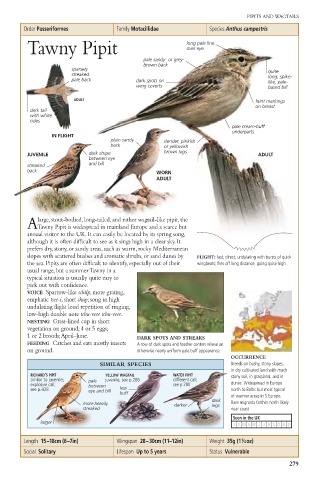
        Tawny Pipit                            long pale line
                                               over eye
                                     pale sandy- or grey-
                                     brown back
                   sparsely                                         quite
                   streaked                                         long, spike-
                   pale back       dark spots on                    like, pale-
                                   wing coverts                     based bill
                   ADULT                                        faint markings
                                                                on breast
        dark tail
        with white
        sides
                                                           pale cream-buff
                                                           underparts
              IN FLIGHT
                             plain sandy  slender, pinkish
                             back         or yellowish
        JUVENILE       dark stripe        brown legs             ADULT
                       between eye
                       and bill
        streaked
        back                            WORN
                                        ADULT


          large, stout-bodied, long-tailed, and rather wagtail-like pipit, the
        ATawny Pipit is widespread in mainland Europe and a scarce but
        annual visitor to the UK. It can easily be located by its spring song,
        although it is often difficult to see as it sings high in a clear sky. It
        prefers dry, stony, or sandy areas, such as warm, rocky Mediterranean
        slopes with scattered bushes and aromatic shrubs, or sand dunes by  FLIGHT: fast, direct; undulating with bursts of quick
        the sea. Pipits are often difficult to identify, especially out of their  wingbeats; flies off long distance, going quite high.
        usual range, but a summer Tawny in a
        typical situation is usually quite easy to
        pick out with confidence.
        VOICE Sparrow-like schilp, more grating,
        emphatic tsee-i, short chup; song in high
        undulating flight loud repetition of ringing,
        low-high double note tchu-veee tchu-veee.
        NESTING Grass-lined cup in short
        vegetation on ground; 4 or 5 eggs;
        1 or 2 broods;April–June.  DARK SPOTS AND STREAKS
        FEEDING Catches and eats mostly insects  A row of dark spots and feather centres relieve an
        on ground.                 otherwise nearly uniform pale buff appearance.
                                                          OCCURRENCE
                          SIMILAR SPECIES                 Breeds on bushy, stony slopes,
                                                          in dry cultivated land with much
         RICHARD’S PIPIT   YELLOW WAGTAIL   WATER PIPIT   stony soil, in grassland, and in
         similar to juvenile;  pale  juvenile; see p.286  different call;
         explosive call;   between          see p.280     dunes. Widespread in Europe
         see p.438     eye and bill  less                 north to Baltic but most typical
                               buff
                                                          of warmer areas in S Europe.
                                                      dark
                      more heavily          darker    legs  Rare migrants farther north likely
                      streaked                            near coast.
                                                           Seen in the UK
           larger
                                                           JF M A  M J  JA S ON D
       Length  15–18cm (6–7in)  Wingspan  28–30cm (11–12in)  Weight  35g (1 1 ⁄4oz)
       Social  Solitary       Lifespan  Up to 5 years  Status  Vulnerable
                                                                         279

