


Page 285 - Complete Birds of Britain and Europe (DK - RSPB)
P. 285
PIPITS AND WAGTAILS
       Order Passeriformes    Family Motacillidae    Species Anthus trivialis
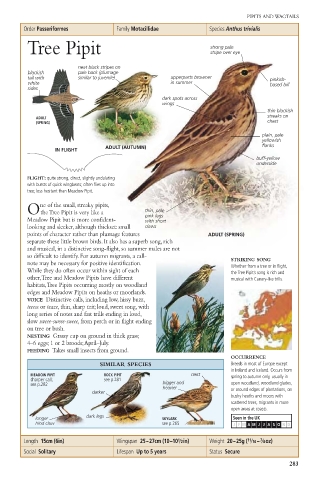
        Tree Pipit                                   strong pale
                                                     stripe over eye
                    neat black stripes on
        blackish    pale back (plumage
        tail with   similar to juvenile)   upperparts browner       pinkish-
        white                              in summer                based bill
        sides
                                         dark spots across
                                         wings
                                                                   thin blackish
                                                                   streaks on
          ADULT
          (SPRING)                                                 chest
                                                                  plain, pale
                                                                  yellowish
                           ADULT (AUTUMN)                         flanks
               IN FLIGHT
                                                                 buff-yellow
                                                                 underside
        FLIGHT: quite strong, direct, slightly undulating
        with bursts of quick wingbeats; often flies up into
        tree; less hesitant than Meadow Pipit.
           ne of the small, streaky pipits,
        Othe Tree Pipit is very like a  thin, pale
                                     pink legs
        Meadow Pipit but is more confident-  with short
        looking and sleeker, although thickset: small  claws
        points of character rather than plumage features  ADULT (SPRING)
        separate these little brown birds. It also has a superb song, rich
        and musical, in a distinctive song-flight, so summer males are not
        so difficult to identify. For autumn migrants, a call-  STRIKING SONG
        note may be necessary for positive identification.  Whether from a tree or in flight,
        While they do often occur within sight of each    the Tree Pipit’s song is rich and
        other,Tree and Meadow Pipits have different       musical with Canary-like trills.
        habitats,Tree Pipits occurring mostly on woodland
        edges and Meadow Pipits on heaths or moorlands.
        VOICE Distinctive calls, including low, hissy buzz,
        teeess or teaze, thin, sharp tzit; loud, sweet song, with
        long series of notes and fast trills ending in loud,
        slow sweee-sweee-sweee, from perch or in flight ending
        on tree or bush.
        NESTING Grassy cup on ground in thick grass;
        4–6 eggs; 1 or 2 broods;April–July.
        FEEDING Takes small insects from ground.
                                                          OCCURRENCE
                          SIMILAR SPECIES                 Breeds in most of Europe except
                                                          in Ireland and Iceland. Occurs from
         MEADOW PIPIT      ROCK PIPIT           crest     spring to autumn only, usually in
         sharper call;     see p.281
         see p.282                       bigger and       open woodland, woodland glades,
                                         heavier          or around edges of plantations, on
                        darker
                                                          bushy heaths and moors with
                                                          scattered trees; migrants in more
                                                          open areas at coasts.
          longer      dark legs          SKYLARK           Seen in the UK
          hind claw                      see p.265         J  F  M  A  M  JJ A S O  N  D
       Length  15cm (6in)     Wingspan  25–27cm (10–10 1 ⁄2in)  Weight  20–25g ( 11 ⁄16 – 7 ⁄8oz)
       Social  Solitary       Lifespan  Up to 5 years  Status  Secure
                                                                         283

