


Page 282 - Complete Birds of Britain and Europe (DK - RSPB)
P. 282
PIPITS AND WAGTAILS
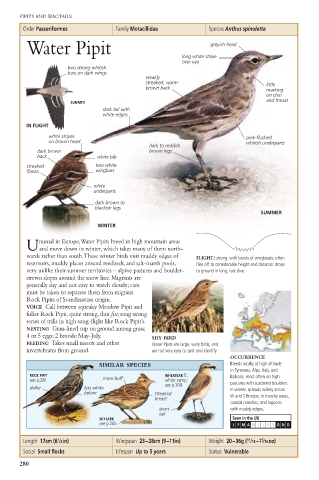
       Order Passeriformes    Family Motacillidae    Species Anthus spinoletta
        Water Pipit                                  greyish head
                                              long white stripe
                                              over eye
                  two strong whitish
                  bars on dark wings
                                     weakly
                                     streaked, warm                little
                                     brown back                    marking
                                                                   on chin
                                                                   and throat
                   SUMMER
                           dark tail with
                           white edges
        IN FLIGHT
             white stripes                                    pink-flushed
             on brown head                                    whitish underparts
                                      dark to reddish
          dark brown                  brown legs
          back           white bib
        streaked         two white
        flanks           wingbars
                        white
                        underparts
                         dark brown to
                         blackish legs
                                                                  SUMMER
                         WINTER
           nusual in Europe,Water Pipits breed in high mountain areas
        Uand move down in winter, which takes many of them north-
        wards rather than south.These winter birds visit muddy edges of  FLIGHT: strong, with bursts of wingbeats; often
        reservoirs, muddy places around reedbeds, and salt-marsh pools,  flies off to considerable height and distance; drops
        very unlike their summer territories – alpine pastures and boulder-  to ground in long, fast dive.
        strewn slopes around the snow line. Migrants are
        generally shy and not easy to watch closely; care
        must be taken to separate them from migrant
        Rock Pipits of Scandinavian origin.
        VOICE Call between squeaky Meadow Pipit and
        fuller Rock Pipit, quite strong, thin fist; song strong
        series of trills in high song-flight like Rock Pipit’s.
        NESTING Grass-lined cup on ground among grass;
        4 or 5 eggs; 2 broods; May–July.  SHY BIRD
        FEEDING Takes small insects and other  Water Pipits are large, wary birds, and
        invertebrates from ground.     are not very easy to spot and identify.
                                                          OCCURRENCE
                          SIMILAR SPECIES                 Breeds locally at high altitude
                                                          in Pyrenees, Alps, Italy, and
        ROCK PIPIT         more buff      WHEATEAR 2;     Balkans, most often on high
        see p.281                         white rump;     pastures with scattered boulders.
                                          see p.300
        duller        less white                          In winter, spreads widely across
                      below            streaked           W and S Europe, in marshy areas,
                                       breast
                                                          coastal marshes, and lagoons
                                         short            with muddy edges.
                                         tail
                          SKYLARK                          Seen in the UK
                          see p.265                        J  F  M  A  M  JJ A S O  N  D
       Length  17cm (6 1 ⁄2in)  Wingspan  23–28cm (9–11in)  Weight  20–36g ( 11 ⁄16 –1 5 ⁄16oz)
       Social  Small flocks   Lifespan  Up to 5 years  Status  Vulnerable
      280

