


Page 284 - Complete Birds of Britain and Europe (DK - RSPB)
P. 284
PIPITS AND WAGTAILS
       Order Passeriformes    Family Motacillidae    Species Anthus pratensis
        Meadow Pipit                               pale stripe
                                                   over eye

                                             dark streak or        slim, weak,
                                             patch on sides        all-dark bill
                                             of neck
                                 soft blackish streaks on
                                 greyish, olive-, or
                                 yellowish brown back
                                 (darker on juvenile)
         dark tail
         with broad
         white sides                                            evenly streaked
                          ADULT                                 chest and flanks
                                                            olive-buff or creamy
                    IN FLIGHT
                                                            underside (yellower
                                                            on juvenile)
          small, streaky brown
        Abird, the Meadow                pale orange-
                                         brown legs
        Pipit is worth looking at                                 ADULT
        closely for the subtleties
        and beautiful patterns of its    very long
                                         hind claw
        plumage. It gives the impression of
        constant nervous energy and worry; its calls
        may have a slightly hysterical quality.Winter flocks
        make shorter calls, more like the “pip-it” of their name. In summer,
        Meadow Pipits prefer heaths and wide open moors, often quite
        boggy places up on the hills.Their tinkling songs are characteristic
        of summer days in the open hills. In winter, many move to open
        farmland.These common, widespread birds often fall prey to Merlins  FLIGHT: quite slow, erratic bounds and slight undu-
        and are parasitized by Cuckoos.           lations with bursts of wingbeats; flies up weakly, jerkily.
        VOICE Sharp, weak, squeaked pseeep
        or tsee, frenetic repetition in alarm;
        winter flocks have short, quiet pip,
        pi-pip calls, short tit; song long series
        of simple repeated notes and trills, in
        parachuting song-flight starting and
        ending on ground.
        NESTING Nest lined with fine stems
        in grass on ground; 4 or 5 eggs;
        2 broods; May–July.
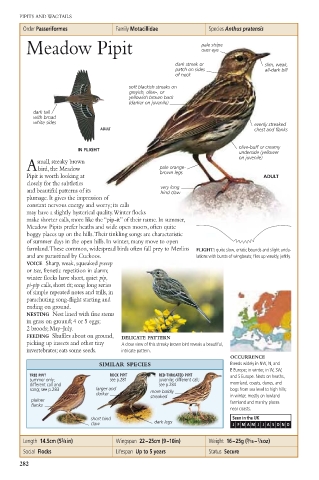
        FEEDING Shuffles about on ground,  DELICATE PATTERN
        picking up insects and other tiny  A close view of this streaky brown bird reveals a beautiful,
        invertebrates; eats some seeds.  intricate pattern.
                                                          OCCURRENCE
                          SIMILAR SPECIES                 Breeds widely in NW, N, and
                                                          E Europe; in winter, in W, SW,
        TREE PIPIT          ROCK PIPIT  RED-THROATED PIPIT  and S Europe. Nests on heaths,
        summer only;        see p.281   juvenile; different call;
        different call and              see p.284         moorland, coasts, dunes, and
        song; see p.283   larger and  more boldly         bogs from sea level to high hills;
                         darker
                                      streaked            in winter, mostly on lowland
         plainer                                          farmland and marshy places
         flanks
                                                          near coasts.
                        short hind                         Seen in the UK
                        claw           dark legs           J  F  M  A  M  JJ A S O  N  D
       Length  14.5cm (5 3 ⁄4in)  Wingspan  22–25cm (9–10in)  Weight  16–25g ( 9 ⁄16 – 7 ⁄8oz)
       Social  Flocks         Lifespan  Up to 5 years  Status  Secure
      282

