


Page 287 - Complete Birds of Britain and Europe (DK - RSPB)
P. 287
PIPITS AND WAGTAILS
       Order Passeriformes    Family Motacillidae    Species Motacilla alba
        Pied Wagtail                     black cap, chin, and

                                         throat (white chin         whitish
                                         and throat outside         face
                                         breeding season)
                     white streaks
        blackish     on wings
        rump                              black back                  black
                              greyer back                             breast
                              than male’s
          MALE                                                      sooty
          (SUMMER)
                                                                    flanks
                        FEMALE
                        (PIED)
                                                                  white belly
                IN FLIGHT
          greyer head and
          upperparts than
          adult male’s
                                long, white-edged
                                black tail
                           buffish
                           below
                                    MALE
        JUVENILE
                                    (SUMMER; PIED)
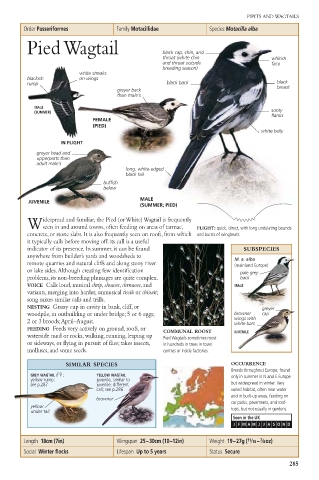
            idespread and familiar, the Pied (or White) Wagtail is frequently
        Wseen in and around towns, often feeding on areas of tarmac,  FLIGHT: quick, direct, with long undulating bounds
        concrete, or stone slabs. It is also frequently seen on roofs, from which  and bursts of wingbeats.
        it typically calls before moving off: its call is a useful
        indicator of its presence. In summer, it can be found  SUBSPECIES
        anywhere from builder’s yards and woodsheds to     M. a. alba
        remote quarries and natural cliffs and along stony river  (mainland Europe)
        or lake sides.Although creating few identification   pale grey
        problems, its non-breeding plumages are quite complex.  back
        VOICE Calls loud, musical chrip, chuwee, chrruwee, and  MALE
        variants, merging into harder, unmusical tissik or chiswit;
        song mixes similar calls and trills.
        NESTING Grassy cup in cavity in bank, cliff, or           greyer
        woodpile, in outbuilding or under bridge; 5 or 6 eggs;  browner  cap
        2 or 3 broods;April–August.                        wings with
                                                           white bars
        FEEDING Feeds very actively on ground, roofs, or  COMMUNAL ROOST  JUVENILE
        waterside mud or rocks, walking, running, leaping up  Pied Wagtails sometimes roost
        or sideways, or flying in pursuit of flies; takes insects,  in hundreds in trees in town
        molluscs, and some seeds.         centres or inside factories.
                 SIMILAR SPECIES                          OCCURRENCE
                                                          Breeds throughout Europe; found
         GREY WAGTAIL 32;  YELLOW WAGTAIL                 only in summer in N and E Europe
         yellow rump;    juvenile, similar to
         see p.287       juvenile; different              but widespread in winter. Very
                         call; see p.286                  varied habitat, often near water
                                                          and in built-up areas, feeding on
                         browner
                                                          car parks, pavements, and roof-
         yellow                                           tops, but not usually in gardens.
         under tail
                                                           Seen in the UK
                                                           J  F  M  A  M  JJ A S O  N  D
       Length  18cm (7in)     Wingspan  25–30cm (10–12in)  Weight  19–27g ( 11 ⁄16 – 7 ⁄8oz)
       Social  Winter flocks  Lifespan  Up to 5 years  Status  Secure
                                                                         285

